
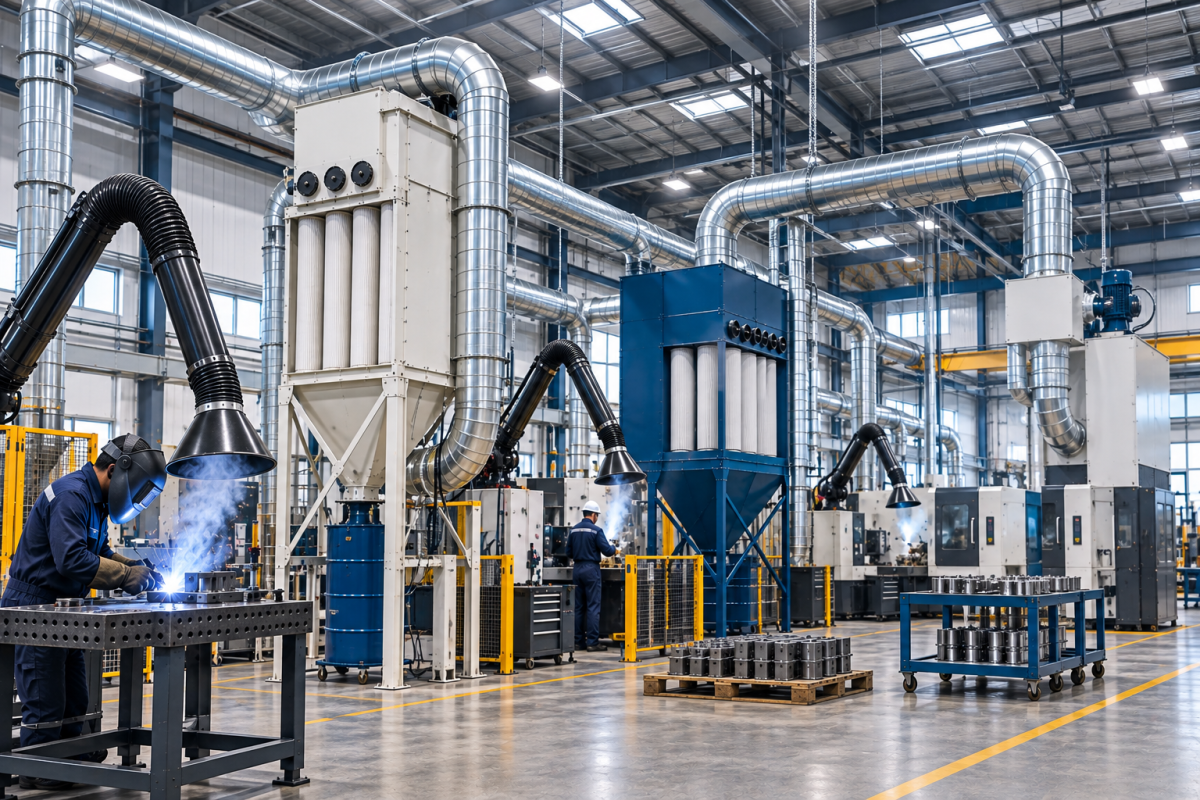
Industrial manufacturing processes generate different types of airborne contaminants, from coarse dust and fine particulate to welding fumes, oil mist, smoke, and vapours. Because these contaminants behave differently in an air stream, no single filtration technology is suitable for every industrial application.
Choosing the right industrial air filtration systems requires understanding the contaminant, particle characteristics, concentration, airflow, temperature, process conditions, and required level of filtration.
This guide explains the major industrial air filters, fume filtration systems, and dust filtration systems, and where each technology is typically used.
Key Takeaways
- Different industrial contaminants require different filtration technologies.
- Baghouse and cartridge collectors are commonly used for industrial dust collection.
- Fume filtration systems are designed for fine particulate generated by processes such as welding.
- Oil and coolant mist require mist-specific filtration rather than conventional dry dust filters.
- HEPA filtration can provide high-efficiency particulate filtration when the application requires it.
- Wet scrubbers can be suitable for certain particulate and gaseous contaminants.
- Filter selection should consider both filtration efficiency and the complete extraction system.
What Are Industrial Air Filtration Systems?
Industrial air filtration systems are engineered systems designed to remove airborne contaminants generated by manufacturing and industrial processes.
A typical system may include:
- Capture hood or enclosure
- Ductwork
- Pre-filtration or separation
- Main filtration stage
- Blower
- Dust or contaminant collection
- Control and monitoring equipment
The filtration equipment is only one part of the overall system. If contaminants are not captured effectively at the source or the airflow is inadequate, even a high-efficiency filter may not provide the expected results.
Why Filter Selection Matters
Industrial contaminants can vary significantly.
For example, grinding may generate relatively heavy metal particles, while welding can produce much finer fumes. CNC machining may generate an aerosol of oil or coolant droplets rather than dry particulate.
The filtration technology therefore needs to match the contaminant.
Important selection factors include:
- Particle size
- Dust loading
- Contaminant concentration
- Airflow
- Temperature
- Moisture
- Chemical characteristics
- Filter media compatibility
- Required filtration efficiency
- Pressure drop
- Operating hours
- Maintenance requirements
Major Industrial Air Filtration Technologies
1. Baghouse Dust Collectors
Baghouse collectors use fabric filter bags to separate particulate from an air stream.
Contaminated air enters the collector and passes through the filter bags. Dust accumulates on the filter surface while cleaner air passes through.
Baghouse systems are commonly used for applications involving:
- Grinding
- Material handling
- Foundries
- Mineral processing
- Wood processing
- Heavy manufacturing
- High dust loading
Their ability to handle substantial dust loads makes them an important category of industrial dust filtration systems.
2. Cartridge Dust Collectors
Cartridge collectors use pleated filter elements.
The pleated construction provides a large filtration area within a relatively compact housing, making cartridge systems suitable where installation space is limited.
They are commonly considered for:
- Fine dry dust
- Metalworking
- Grinding
- Cutting
- Welding
- Powder handling
Cartridge collectors can also incorporate automatic cleaning systems to remove accumulated dust from the filter surface.
3. Welding Fume Filtration Systems
Welding generates fine particulate that can remain airborne for extended periods.
Fume filtration systems are designed specifically for applications such as:
- MIG/MAG welding
- TIG welding
- Arc welding
- Robotic welding
- Plasma cutting
- Thermal cutting
Source capture is particularly important for welding because capturing the fume close to the welding operation prevents it from dispersing throughout the workspace.
Depending on the application, systems may use extraction arms, hoods, enclosures, portable extractors, or centralized extraction.
4. Oil and Coolant Mist Filtration
Oil mist and coolant mist generated during CNC machining are aerosols rather than conventional dry dust.
These applications require filtration technologies designed to separate liquid droplets from the air stream.
Mist collectors are commonly used for:
- CNC turning
- Milling
- Grinding
- Drilling
- High-speed machining
- Metalworking
The collector may incorporate multiple filtration stages to capture progressively finer droplets.
Using a dust collector designed for dry particulate does not automatically make it suitable for oil or coolant mist.
5. HEPA Filtration
HEPA filters are designed for high-efficiency removal of very small airborne particles.
They can be incorporated into industrial air filtration systems when the application requires a high level of particulate filtration.
Potential applications include:
- Fine particulate control
- Final filtration
- Controlled production environments
- Specialized manufacturing processes
- Supplementary filtration stages
However, HEPA filters are not automatically the best choice for every industrial dust application.
A heavily loaded process may require a pre-filter or primary dust collector upstream to prevent excessive loading of the HEPA stage.
6. Electrostatic Filtration
Electrostatic precipitators use electrical charges to collect particles from an air stream.
They can be used in certain applications involving:
- Smoke
- Fine particulate
- Oil mist
- Process emissions
Electrostatic systems can be attractive where specific contaminant characteristics and operating conditions make them appropriate.
However, their suitability depends on the application and the properties of the contaminant.
7. Wet Scrubbers
Wet scrubbers use a liquid to capture or absorb contaminants from an air stream.
Depending on their design, scrubbers can be used for certain:
- Dust
- Chemical contaminants
- Acid gases
- Process emissions
- Hot or moisture-laden streams
Wet scrubbers can be particularly useful where dry filtration is unsuitable because of contaminant characteristics or process conditions.
They also introduce additional considerations such as wastewater handling, corrosion, liquid management, and maintenance.
8. Activated Carbon Filtration
Activated carbon is primarily used to adsorb certain gases, vapours, and odorous compounds.
It can be incorporated into a multi-stage filtration system when the process produces contaminants that cannot be adequately controlled through particulate filtration alone.
Activated carbon is therefore fundamentally different from a conventional dust filter.
Comparing Industrial Air Filters
| Technology | Typical Contaminant | Common Application |
|---|---|---|
| Baghouse | Dry particulate, high dust loading | Grinding, material handling |
| Cartridge | Fine dry dust and particulate | Metalworking, powder processing |
| Fume filtration | Welding and process fumes | Welding and thermal processes |
| Mist collector | Oil and coolant aerosols | CNC machining |
| HEPA | Very fine particulate | Final/high-efficiency filtration |
| Electrostatic | Fine particulate, smoke, some mist | Process emissions |
| Wet scrubber | Particulate and selected gases | Chemical/process applications |
| Activated carbon | Vapours and certain gases | Odour and VOC-related applications |
Dust Filtration Systems
Dust filtration systems are primarily designed to remove solid particulate from industrial air.
The appropriate technology depends heavily on the characteristics of the dust.
Coarse Dust
Coarser particles may be relatively easy to separate using appropriate mechanical filtration or pre-separation.
Fine Dust
Fine particles require appropriately selected filter media and sufficient filtration area.
High Dust Loading
Processes producing large quantities of dust may require robust baghouse or cartridge collection systems with effective filter cleaning.
Abrasive Dust
Abrasive particles may require attention to collector construction, duct velocity, wear protection, and filter selection.
Fume Filtration Systems
Fumes are generally finer than conventional dust and can be generated through thermal processes.
Examples include:
- Welding
- Cutting
- Brazing
- Soldering
- Thermal processing
For these applications, the capture method is just as important as the filter.
A welding fume extractor positioned close to the source can prevent the fume from entering the surrounding workplace before filtration occurs.
Filtration Efficiency vs System Performance
A common mistake is to select filtration equipment based only on the filter’s efficiency rating.
Actual system performance also depends on:
Capture Efficiency
Can the system capture the contaminant before it escapes the source?
Airflow
Is sufficient airflow maintained at the extraction point?
Ductwork
Does the duct system transport contaminated air effectively?
Filter Loading
Does accumulated material cause excessive pressure drop?
Cleaning
Can the filter be cleaned effectively during operation?
Maintenance
Are filters, seals, blowers, and other components maintained properly?
A highly efficient filter cannot compensate for poor source capture or inadequate airflow.
Understanding Pressure Drop
As dust accumulates on a filter, resistance to airflow generally increases.
This resistance is commonly monitored through differential pressure.
Increasing pressure drop can indicate:
- Filter loading
- Poor filter cleaning
- Excessive dust loading
- Blocked airflow paths
- Filter deterioration
Monitoring pressure drop helps maintenance teams determine when investigation, cleaning, or filter replacement may be required.
How to Select the Right Industrial Air Filter
A practical selection process begins with the contaminant rather than the equipment.
Step 1: Identify the Contaminant
Determine whether the process produces:
- Dust
- Fume
- Oil mist
- Coolant mist
- Smoke
- Vapour
- Gas
Step 2: Understand Its Characteristics
Evaluate:
- Particle size
- Concentration
- Temperature
- Moisture
- Chemical composition
- Combustibility
- Stickiness
- Abrasiveness
Step 3: Determine Required Airflow
Calculate the airflow required to capture and transport the contaminant effectively.
Step 4: Select the Capture Method
Consider:
- Enclosures
- Extraction arms
- Hoods
- Downdraft tables
- Machine-integrated extraction
- Centralized extraction
Step 5: Select Filtration Technology
Match the filter to the contaminant and process conditions.
Step 6: Evaluate Pressure Drop
The filter and complete extraction system should be evaluated for pressure loss and blower requirements.
Step 7: Plan Maintenance
Consider filter cleaning, replacement, dust discharge, access, inspection, and service requirements before finalizing the system.
Centralized vs Point-of-Use Filtration
Industrial air filtration can be configured in different ways.
Point-of-Use Filtration
A collector is installed directly at or near an individual machine or workstation.
This approach can be useful for:
- Individual CNC machines
- Welding stations
- Small production areas
- Mobile operations
Centralized Filtration
Multiple extraction points are connected to a common filtration system.
This can be suitable for:
- Large manufacturing plants
- Multiple fixed machines
- Production lines
- Facilities requiring centralized dust collection
The choice depends on the number of sources, plant layout, operating schedules, and airflow requirements.
Common Filtration Selection Mistakes
Choosing a Filter Before Identifying the Contaminant
The filter should be selected based on the material being captured, not simply on the desired equipment category.
Focusing Only on Filtration Efficiency
A filter with excellent laboratory efficiency may still perform poorly if source capture and airflow are inadequate.
Ignoring Pressure Drop
Higher resistance increases the workload on the extraction blower and can reduce system performance.
Using the Same Filter for Dust and Mist
Oil and coolant mist behave differently from dry dust and require application-specific filtration.
Undersizing the Collector
Insufficient filtration area or airflow can lead to rapid filter loading and poor extraction.
Ignoring Maintenance
Even the correct filtration technology will lose effectiveness if filters and mechanical components are not maintained properly.
Powertech’s Industrial Filtration Solutions
Powertech develops industrial pollution control systems around the characteristics of the process and contaminant.
Its product categories include:
DustBag
Industrial dust collection systems for applications generating dry particulate and process dust.
FumeKiller
Welding fume extraction and filtration systems designed for source capture of welding and thermal process fumes. Also serves as an oil mist collector for CNC manufacturing processes.
MistKiller
Water-based coolant mist collection systems for CNC machining and metalworking applications.
The appropriate system depends on the contaminant, required airflow, capture arrangement, plant layout, and operating conditions.
Industrial air filtration systems are used to capture and remove airborne contaminants such as dust, fumes, smoke, oil mist, coolant mist, and certain vapours from industrial processes.
Common technologies include baghouse filters, cartridge filters, mist collectors, HEPA filters, electrostatic filtration, wet scrubbers, and activated carbon filtration. Each is designed for particular contaminant and process conditions.
Dust filtration generally addresses solid particulate generated by mechanical processes, while fume filtration is designed for finer particulate generated by thermal processes such as welding and cutting.
There is no single best filter for every dust application. Baghouse and cartridge systems are widely used, but the appropriate choice depends on dust characteristics, loading, airflow, temperature, and required filtration performance.
Yes, HEPA filters can be used when high-efficiency particulate filtration is required. However, they may need appropriate upstream filtration where dust loading is high.
CNC oil and coolant mist generally require dedicated mist collection technology designed to separate liquid aerosols from the air stream.
Start by identifying the contaminant and its characteristics. Then determine the required capture method, airflow, filtration efficiency, pressure drop, operating conditions, maintenance requirements, and plant layout.
Selecting the right industrial air filtration systems requires more than choosing a filter with a high efficiency rating. The contaminant, capture method, airflow, filter loading, pressure drop, and maintenance requirements all influence the performance of the complete system. Baghouse and cartridge collectors are widely used for dust filtration systems, while specialized fume filtration systems address welding and other thermal processes. Oil and coolant mist require dedicated mist collection technology, while HEPA, electrostatic, wet scrubbing, or activated carbon technologies may be appropriate for specific applications. The most effective approach is to begin with the manufacturing process and identify the contaminant before selecting the filtration technology. When capture, airflow, filtration, and maintenance are engineered together, an industrial air filtration system can provide reliable contaminant control while supporting cleaner and more efficient manufacturing operations.