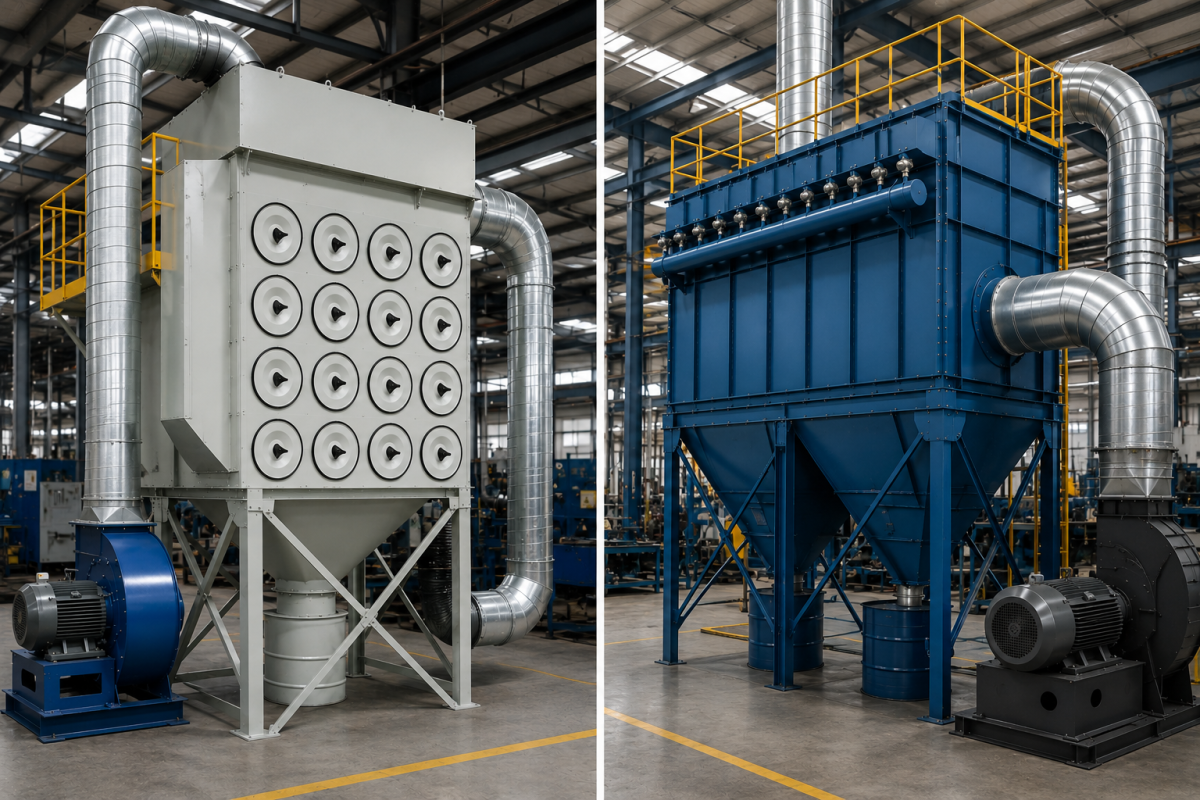
Cartridge vs Baghouse Dust Collectors: Which Is Right for Your Industry?

Introduction

Selecting the right dust collection technology is one of the most important decisions when designing an effective industrial air pollution control system. Two of the most widely used technologies are the cartridge dust collector and the baghouse dust collector. While both are designed to remove airborne particulate matter, they differ significantly in filtration media, operating principles, maintenance requirements, airflow capacity, and ideal applications.

Understanding the differences between these technologies helps manufacturers choose the most suitable industrial dust filtration solution for their process. Whether the application involves metal fabrication, woodworking, pharmaceuticals, cement, food processing, or chemical manufacturing, selecting the correct dust collector directly impacts air quality, equipment performance, maintenance costs, and overall productivity.

This dust collector comparison explains how cartridge and baghouse systems work, their advantages, limitations, and the industries where each technology performs best.

With nearly three decades of experience in industrial air pollution control, Powertech engineers customized DustBag dust collection systems based on the specific dust characteristics and airflow requirements of each application.

Key Takeaways

  1. Cartridge dust collectors are ideal for fine, dry dust and compact installations.
  2. Baghouse dust collectors are designed for high dust loads and continuous heavy-duty operation.
  3. Selecting the right technology depends on particle size, dust loading, airflow, and process conditions.
  4. Proper industrial dust filtration improves air quality, equipment reliability, and operational efficiency.
  5. Engineering evaluation is essential before selecting a dust collection system.

What Is a Cartridge Dust Collector?

A cartridge dust collector uses pleated filter cartridges with a large filtration surface area packed into a compact housing.

Dust-laden air enters the collector, passes through the filter media, and clean air exits the system while dust particles remain trapped on the cartridge surface.

Typical Applications

  1. Laser cutting
  2. Plasma cutting
  3. Welding
  4. Pharmaceutical manufacturing
  5. Food processing
  6. Powder coating
  7. Fine metal dust collection

What Is a Baghouse Dust Collector?

A baghouse dust collector uses long cylindrical fabric filter bags suspended inside a large housing.

Dust accumulates on the outside of the filter bags while clean air passes through the fabric.

Periodic pulse-jet cleaning removes accumulated dust into collection hoppers.

Typical Applications

  1. Cement plants
  2. Foundries
  3. Steel plants
  4. Mining
  5. Mineral processing
  6. Woodworking
  7. Heavy industrial manufacturing

Cartridge vs Baghouse Dust Collectors

FeatureCartridge Dust CollectorBaghouse Dust Collector
Filter MediaPleated cartridgesFabric filter bags
Dust TypeFine, dry dustFine to coarse dust
Airflow CapacityMediumHigh
Dust LoadingModerateHigh
Installation SpaceCompactLarger footprint
MaintenanceCartridge replacementBag replacement
High Temperature ApplicationsLimitedExcellent
Heavy-Duty Industrial UseModerateExcellent
Energy EfficiencyHighHigh
Typical IndustriesManufacturing, pharma, foodCement, foundry, mining, heavy industry

Advantages of Cartridge Dust Collectors

Compact Design

Pleated filters provide a large filtration area within a relatively small footprint.

High Filtration Efficiency

Excellent for capturing fine particulate generated during precision manufacturing.

Lower Air-to-Cloth Ratio

Large filter surface area improves filtration efficiency.

Easy Filter Replacement

Cartridges are generally easier to replace during scheduled maintenance.

Ideal for Indoor Installation

Compact systems integrate well into manufacturing facilities with limited space.

Advantages of Baghouse Dust Collectors

Handles Heavy Dust Loads

Suitable for continuous high-volume dust generation.

Excellent for High Temperatures

Fabric bags are available for demanding thermal applications.

Long Service Life

Properly maintained filter bags provide reliable long-term operation.

Large Airflow Capacity

Ideal for centralized dust collection serving multiple production lines.

Wide Industrial Application

Effective across numerous heavy manufacturing industries.

Choosing the Right Industrial Dust Filtration System

Several factors influence the selection between cartridge and baghouse technology.

Dust Characteristics

  1. Particle size
  2. Dust loading
  3. Moisture content
  4. Abrasiveness

Airflow Requirements

Higher airflow applications often favor baghouse systems.

Process Temperature

High-temperature processes generally require baghouse collectors with specialized filter media.

Available Installation Space

Compact facilities often benefit from cartridge systems.

Maintenance Strategy

Ease of access and filter replacement should be considered during system design.

Common Industries Using Cartridge Collectors

  1. Electronics manufacturing
  2. Pharmaceutical production
  3. Food processing
  4. Automotive component manufacturing
  5. Laser cutting
  6. Welding shops
  7. Powder handling

Common Industries Using Baghouse Collectors

  1. Cement manufacturing
  2. Steel plants
  3. Foundries
  4. Mining
  5. Woodworking
  6. Chemical processing
  7. Bulk material handling

Powertech’s Engineering Approach

Rather than recommending a single technology for every application, Powertech evaluates:

  1. Dust particle characteristics
  2. Airflow requirements
  3. Production process
  4. Operating temperature
  5. Dust loading
  6. Plant layout
  7. Maintenance preferences
  8. Future expansion plans

This engineering-first approach ensures every DustBag system is optimized for long-term performance and operating efficiency.

Expert Insight

From Powertech’s experience, many buyers focus only on filtration efficiency while overlooking dust loading, operating temperature, and maintenance requirements.

A cartridge collector may outperform a baghouse in one application, while the opposite may be true in another. The most successful installations are those where the dust collection technology is selected based on actual process conditions rather than equipment size or initial purchase cost.

What is a cartridge dust collector?

A cartridge dust collector uses pleated filter cartridges to capture fine airborne dust while providing a large filtration area within a compact housing.

What is a baghouse dust collector?

A baghouse dust collector uses cylindrical fabric filter bags to separate dust from the airflow, making it suitable for high dust loads and continuous industrial operation.

Which dust collector is better for fine dust?

Cartridge dust collectors are generally preferred for fine, dry dust generated in precision manufacturing applications.

Which system is better for heavy industrial applications?

Baghouse dust collectors are typically better suited for high-volume dust generation and heavy industrial manufacturing.

Can cartridge collectors replace baghouse systems?

Not always. The correct technology depends on airflow requirements, dust characteristics, operating temperature, and process conditions.

How do I choose the right dust collector?

An engineering assessment of dust type, airflow, temperature, production process, and maintenance requirements is the most effective way to select the appropriate dust collection system.

Conclusion

Choosing between a cartridge dust collector and a baghouse dust collector depends on the specific requirements of the manufacturing process. While cartridge systems offer compact, high-efficiency industrial dust filtration for fine particulate applications, baghouse collectors provide exceptional performance for high dust loads, elevated temperatures, and continuous industrial operation. A professional dust collector comparison should always consider airflow, dust characteristics, process conditions, and long-term operating costs rather than equipment size alone. With decades of expertise in industrial air pollution control, Powertech designs DustBag dust collection systems that deliver reliable, customized solutions for a wide range of industrial applications.

Electrostatic Mist Collectors vs Mechanical Mist Collectors

Introduction

Mist collection systems play a critical role in controlling airborne contaminants generated during CNC machining, metal cutting, grinding, and industrial manufacturing processes. Whether the contaminant is oil mist, coolant mist, smoke, or ultra-fine aerosols, selecting the right collection technology directly impacts air quality, operating costs, maintenance requirements, and overall system performance.

Two of the most common technologies used for industrial mist control are the electrostatic mist collector and the mechanical mist collector. While both are designed to remove airborne contaminants, they operate using different principles and are suited to different applications.

Understanding the differences between these technologies helps manufacturers choose the most effective oil mist filtration system for their operations and improve overall industrial mist extraction performance.

With nearly 30 years of experience in industrial air pollution control, Powertech designs customized mist collection solutions for machining, manufacturing, and process industries requiring reliable airborne contaminant control.

Key Takeaways

  1. Electrostatic mist collectors use electrical charging and collection plates to capture contaminants.
  2. Mechanical mist collectors use centrifugal, filtration, or inertial separation methods.
  3. Electrostatic systems excel at ultra-fine mist and smoke removal.
  4. Mechanical systems typically require less electrical complexity and lower initial investment.
  5. The best choice depends on contaminant type, airflow requirements, and maintenance considerations.

What Is an Electrostatic Mist Collector?

An electrostatic mist collector removes airborne contaminants by electrically charging particles and collecting them on oppositely charged collection plates.

Process

  1. Contaminated air enters the collector.
  2. Particles receive an electrical charge.
  3. Charged particles are attracted to collection plates.
  4. Cleaned air exits the system.

Common Applications

  1. Oil smoke collection
  2. EDM machining
  3. Heat treatment operations
  4. Fine oil mist extraction
  5. Metalworking processes

What Is a Mechanical Mist Collector?

A mechanical mist collector uses physical separation methods rather than electrical charging.

Common Technologies

  1. Centrifugal separation
  2. Impingement separation
  3. Multi-stage filtration
  4. Inertial separation

Process

  1. Contaminated air enters the collector.
  2. Mist droplets are separated mechanically.
  3. Collected liquid drains into a collection chamber.
  4. Cleaned air is discharged.

Common Applications

  1. CNC machining centers
  2. Milling machines
  3. Turning centers
  4. Water-based coolant mist extraction
  5. General machining operations

Electrostatic vs Mechanical Mist Collection

FeatureElectrostatic Mist CollectorMechanical Mist Collector
Collection MethodElectrical chargingPhysical separation
Ultra-Fine Particle RemovalExcellentGood
Oil Smoke ControlExcellentModerate
Coolant Mist ControlGoodExcellent
Initial CostHigherLower
Electrical ComponentsMore complexSimpler
Coolant RecoveryLimitedExcellent
Maintenance RequirementsPlate cleaning requiredGenerally lower
Continuous Heavy-Duty MachiningGoodExcellent

Performance Comparison

Electrostatic Mist Collectors

Advantages

  1. High efficiency for ultra-fine particles
  2. Excellent oil smoke removal
  3. Suitable for difficult aerosol applications
  4. High collection efficiency

Limitations

  1. Higher capital cost
  2. Requires cleaning of collection plates
  3. More complex electrical systems

Mechanical Mist Collectors

Advantages

  1. Robust operation
  2. Lower maintenance complexity
  3. Excellent coolant recovery
  4. Suitable for continuous machining environments
  5. Lower operating costs

Limitations

  1. May be less effective for ultra-fine smoke
  2. Performance depends on contaminant characteristics

Best Applications for Electrostatic Mist Collectors

EDM Operations

Produces extremely fine aerosols.

Oil Smoke Applications

Ideal for thermal oil smoke generation.

Heat Treatment Facilities

Effective for smoke and vapor control.

High-Temperature Processes

Suitable where ultra-fine particles dominate.

Best Applications for Mechanical Mist Collectors

CNC Machining Centers

Ideal for coolant mist extraction.

Turning Operations

Continuous mist generation.

Milling Machines

Effective for water-based coolant mist.

Precision Engineering Facilities

Reliable and low-maintenance operation.

Powertech’s Recommendation

For most CNC machining operations using water-based coolants, centrifugal mechanical mist collection technology typically offers the best balance of:

  1. Extraction efficiency
  2. Coolant recovery
  3. Reliability
  4. Maintenance requirements
  5. Operating costs

This is why Powertech’s MistKiller™ system uses centrifugal separation technology specifically designed for machining-generated coolant mist.

For specialized oil smoke or ultra-fine aerosol applications, the FumeKiller® unit serves as an electrostatic collection technology that may offer advantages depending on the contaminant characteristics.

Expert Insight

Powertech’s field experience shows that many facilities choose mist collection technologies based solely on filtration efficiency without considering:

  1. Contaminant type
  2. Maintenance requirements
  3. Coolant recovery potential
  4. Long-term operating costs

The most successful installations are those that match the collection technology to the actual process conditions.

What is an electrostatic mist collector?

An electrostatic mist collector uses electrically charged collection plates to remove airborne mist and smoke particles.

What is a mechanical mist collector?

A mechanical mist collector uses physical separation methods such as centrifugal force or filtration to remove contaminants.

Which collector is better for CNC machining?

Mechanical mist collectors are generally preferred for water-based coolant mist generated during CNC machining operations.

Are electrostatic mist collectors better for oil smoke?

Yes. Electrostatic systems often provide superior performance for ultra-fine oil smoke applications.

Which system requires less maintenance?

Mechanical mist collectors typically have simpler maintenance requirements, although this depends on system design and operating conditions.

Conclusion

Choosing between an electrostatic mist collector and a mechanical mist collector depends largely on the type of airborne contaminant being generated. While electrostatic systems excel at removing ultra-fine smoke and aerosols, mechanical systems are often the preferred choice for coolant mist extraction and general machining applications. By selecting the appropriate oil mist filtration system and implementing effective industrial mist extraction, manufacturers can significantly improve workplace air quality, equipment cleanliness, and operational efficiency. Powertech continues to provide engineered mist collection solutions tailored to the specific requirements of modern machining and manufacturing environments.

Case Study: How FumeKiller® Improved Air Quality in a Welding Shop

In the industrial sector, maintaining air quality is a critical concern, especially in environments where hazardous fumes are prevalent. Welding shops, in particular, face significant challenges due to the production of toxic fumes and particulates during welding processes. Poor air quality not only poses health risks to workers but also affects overall operational efficiency. This case study explores how Powertech Pollution Controls’ FumeKiller® significantly improved air quality in a welding shop, enhancing both worker safety and productivity.

The client, a medium-sized welding shop specializing in the fabrication of automotive components, was grappling with severe air quality issues. The shop employed over 30 welders who worked in close proximity to each other, increasing the risk of exposure to harmful fumes. The management had received numerous complaints from employees about respiratory problems, eye irritation, and overall discomfort.

Recognizing the urgency of the situation, the team from Powertech Pollution Controls completed a comprehensive study of the application and it was decided that the FumeKiller®, due to its advanced technology, superior filtration capabilities, and proven track record in similar industrial settings, would be used as welding fume extractor to provide a solution for the issue.

The FumeKiller® is an electrostatic fume extraction system designed to capture and neutralize welding fumes at the source. It utilizes a combination of mechanical filtration and electrostatic precipitation to remove even the finest particulates and gaseous pollutants from the air. The system is equipped with high-efficiency filters that trap large particles, while the electrostatic precipitator charges and collects smaller particles, ensuring comprehensive air purification.

The entire system was designed such that each welding station would be equipped with a single portable FumeKiller® unit, which would be equipped with a flexible extractor arm to ensure that the fume extraction hood was placed as close as possible, ideally within 8 – 10 inches, from the fume generation point. This system would ensure that the FumeKiller® could be repositioned at any point of time in case the welding station is moved to a different location.

Within weeks of installation, the welding shop began to experience noticeable improvements in air quality. The FumeKiller® effectively captured and removed welding fumes, significantly reducing the concentration of airborne pollutants. Workers reported a marked decrease in respiratory issues and eye irritation, and overall comfort levels improved. The improved air quality also contributed to a more pleasant and productive working environment, boosting employee morale and satisfaction.

In addition to health benefits, the FumeKiller® provided substantial operational advantages. The reduction in airborne particulates minimized equipment malfunctions and maintenance requirements, leading to lower operational costs and increased efficiency

Moreover, the FumeKiller®’s advanced filtration system ensured that the welding shop complied with stringent environmental and safety regulations. By maintaining air quality standards, the shop avoided potential fines and legal issues, reinforcing its commitment to worker safety and environmental responsibility.

The success of the FumeKiller® as a portable welding fume extractor underscored the importance of investing in high-quality air pollution control solutions. The positive impact of the installed welding fume extractors in this welding shop serves as a compelling example for other industrial facilities facing similar air quality challenges. It demonstrates that with the right technology and expert support, it is possible to create a cleaner, safer, and more efficient work environment. For more information about the FumeKiller® and other air pollution control solutions, visit our product page or contact us today.