
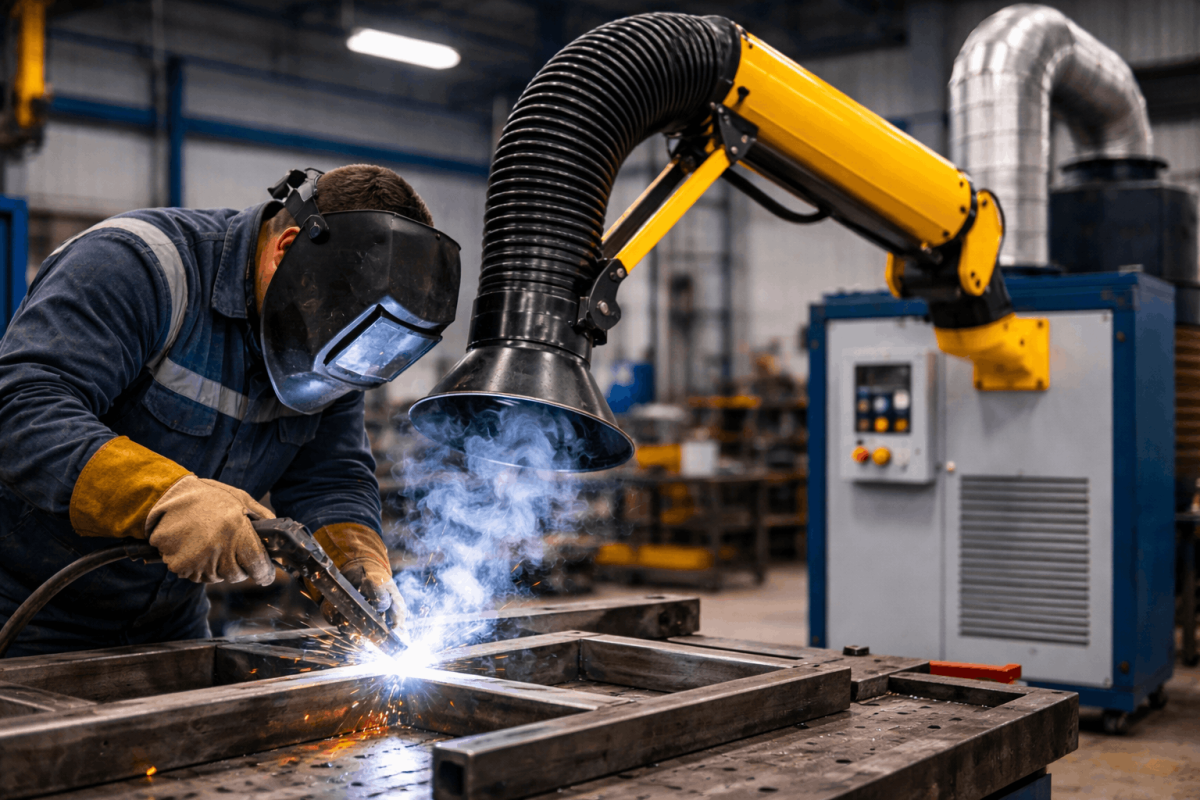
How Welding Fume Extractors Capture Fumes at the Source
Introduction
Welding operations are a critical part of industrial fabrication, but they generate hazardous fumes composed of fine metal particulates and gases. These fumes, if not effectively controlled, disperse into the work environment and expose workers to harmful contaminants. In fabrication shops where multiple welding stations operate simultaneously, this issue becomes significantly more pronounced.
Traditional ventilation methods often rely on general air dilution, which does not effectively remove contaminants from the welder’s breathing zone. As a result, airborne pollutants remain suspended and continue to pose risks to both workers and equipment.
A welding fume extractor addresses this challenge by capturing fumes directly at the point of generation. This method, known as source capture welding fumes, is far more effective than general ventilation. By using properly designed local exhaust ventilation welding systems and flexible welding extraction arm setups, industries can significantly improve air quality and maintain safer working conditions.
Key Takeaways
- A welding fume extractor captures fumes directly at the source, preventing dispersion into the workspace.
- Local exhaust ventilation welding is more effective than general ventilation for controlling welding fumes.
- Proper positioning of the welding extraction arm is critical for effective fume capture.
- Source capture systems improve worker safety, visibility, and compliance with industrial safety standards.
The Problem: Ineffective Fume Control in Welding Environments
Welding fumes are generated instantly when metals are heated, vaporized, and condensed into fine airborne particles. Without immediate capture, these particles spread rapidly across the workspace.
Causes of Poor Fume Control
- Over-reliance on general ventilation systems
- Incorrect placement of extraction arms
- Insufficient airflow at the point of welding
- Multiple welding operations in confined spaces
- Lack of system maintenance and filter clogging
Workplace Impact
- Smoke accumulation reducing visibility
- Worker discomfort due to poor air quality
- Deposition of metal particles on machinery
- Reduced efficiency in fabrication processes
Safety Risks
- Exposure to toxic metals such as manganese and chromium
- Respiratory illnesses and long-term lung damage
- Increased risk of occupational health violations
- Reduced operator alertness in poor air conditions
These challenges highlight the importance of using a welding fume extractor designed specifically for source capture.
How a Welding Fume Extractor Captures Fumes at the Source
A welding fume extractor works by creating localized airflow that pulls contaminants away from the welding arc before they disperse.
Step 1: Positioning the Extraction Arm
The welding extraction arm is placed close to the welding arc, typically within 150–300 mm.
- This proximity ensures immediate capture
- Prevents fumes from entering the breathing zone
- Improves capture efficiency significantly
Step 2: Creating Negative Pressure
The extractor unit generates suction using a high-efficiency fan.
- Negative pressure draws fumes into the hood
- Airflow direction is controlled toward the extractor
- Capture velocity is maintained at required levels
Step 3: Capturing and Conveying Fumes
Once captured, fumes are drawn through the extraction arm into the system.
- Smooth internal ducting reduces pressure losses
- Consistent airflow ensures stable performance
- Multiple arms can connect to a central unit
Step 4: Filtration of Contaminants
The contaminated air passes through filtration stages:
- Pre-filters capture larger particles
- Cartridge filters remove fine particulate matter
- Optional HEPA filters capture ultra-fine particles
Step 5: Clean Air Discharge
After filtration:
- Clean air is either recirculated into the workspace
- Or safely exhausted outside the facility
This entire process ensures effective source capture welding fumes and maintains safe air quality levels.
Capture Efficiency and Airflow Guidelines
Proper airflow and capture velocity are critical for the performance of a welding fume extractor.
| Parameter | Recommended Range | Remarks |
| Capture distance | 150 – 300 mm | Closer distance improves efficiency |
| Capture velocity | 0.5 – 1.5 m/s | Depends on welding intensity |
| Airflow per arm | 800 – 1500 m³/hr | Varies with hood size |
| Filter efficiency | Up to 99% | With multi-stage filtration |
| Static pressure | 800 – 1500 Pa | Depends on duct design |
Engineering design must ensure that airflow remains consistent across all extraction points.
Practical Industrial Applications
Automotive Manufacturing
Automotive plants use robotic and manual welding extensively. Fixed extraction hoods and centralized systems ensure continuous fume capture in high-volume production environments.
Fabrication Shops
Fabrication shops rely heavily on flexible welding extraction arm systems.
- Operators can reposition arms easily
- Suitable for varying workpiece sizes
- Ideal for multi-station workshops
Electronics Manufacturing
In electronics manufacturing, micro-welding and soldering produce fine fumes.
Compact welding fume extractor units provide localized extraction without affecting precision work.
CNC and Equipment Manufacturing
Welding operations in CNC shops require localized extraction to prevent contamination of precision machining areas.
Integrated systems ensure clean air without disrupting adjacent processes.
Expert Insight
One of the most common mistakes in industrial setups is placing the extraction arm too far from the welding arc. Even a small increase in distance can drastically reduce capture efficiency.
From a practical engineering standpoint:
- Keep the extraction hood within 200 mm whenever possible
- Avoid cross drafts that disrupt airflow
- Regularly check airflow performance and filter condition
A well-positioned welding fume extractor can achieve significantly higher efficiency without increasing system capacity.
Frequently Asked Questions
Q. What is source capture in welding?
A. Source capture refers to capturing welding fumes directly at the point where they are generated, preventing them from spreading into the workspace.
Q. How does a welding extraction arm work?
A. A welding extraction arm positions the suction inlet close to the welding arc, allowing fumes to be drawn into the extractor system immediately.
Q. Why is local exhaust ventilation important in welding?
A. Local exhaust ventilation welding systems remove contaminants directly from the source, making them more effective than general ventilation methods.
Q. What affects the efficiency of a welding fume extractor?
A. Key factors include:
- Distance from the welding arc
- Airflow rate
- Hood design
- Filter condition
Q. Can one extractor serve multiple welding stations?
A. Yes, centralized systems can connect multiple extraction arms to a single unit, provided airflow is properly balanced.
Conclusion
Welding fumes pose a significant challenge in industrial environments, particularly in fabrication shops where continuous operations generate high volumes of airborne contaminants. General ventilation alone is not sufficient to control these fumes effectively.
A properly designed welding fume extractor provides an efficient solution by capturing contaminants at the source. Through effective local exhaust ventilation welding systems and correctly positioned welding extraction arm setups, industries can significantly improve air quality and worker safety.
Implementing source capture strategies not only enhances workplace conditions but also ensures compliance with industrial safety standards. As fabrication processes continue to evolve, investing in effective welding fume extraction solutions remains essential for maintaining a safe and efficient industrial environment.