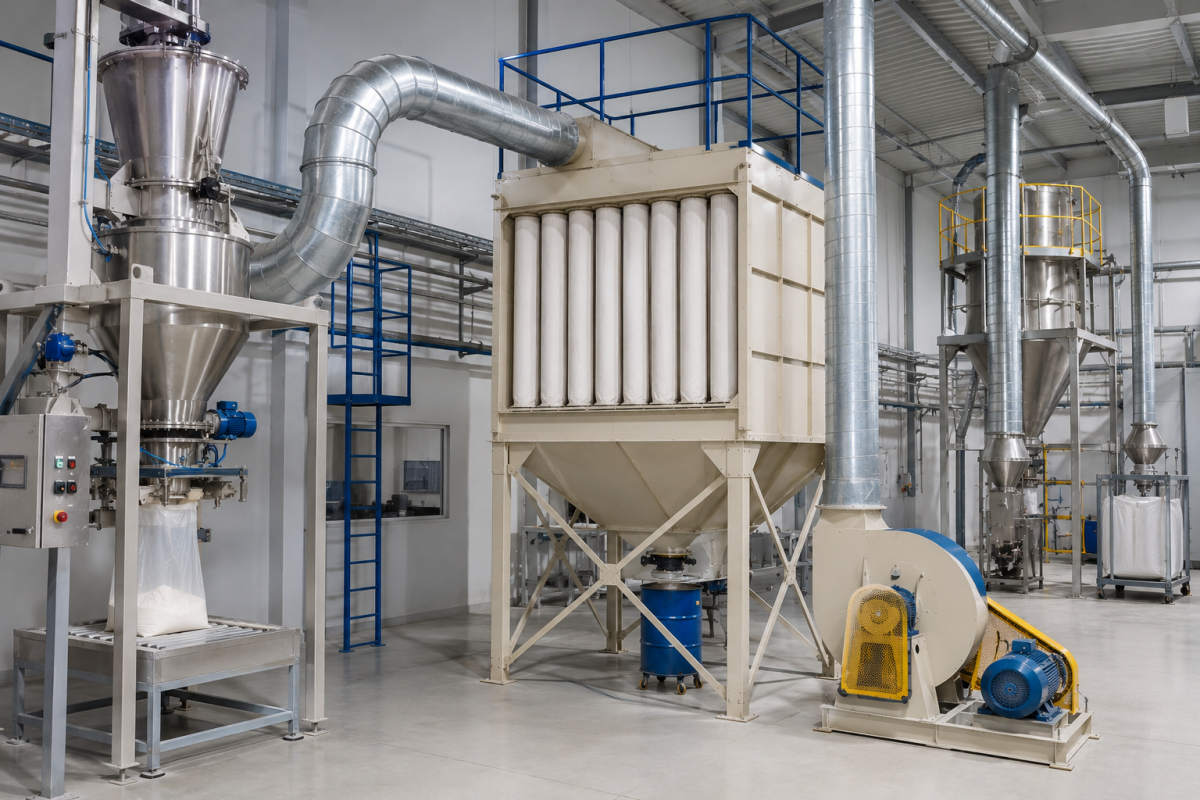
Pharmaceutical manufacturing requires careful control of airborne dust, powders, aerosols, and other process contaminants. Operations such as dispensing, weighing, blending, granulation, tablet compression, coating, and material transfer can release fine pharmaceutical powders into the production environment.
Effective pharmaceutical dust collection focuses on capturing these contaminants at their source while maintaining appropriate filtration, containment, hygiene, and ventilation conditions.
Unlike many conventional industrial applications, pharmaceutical facilities may have additional requirements related to product contamination, cross-contamination, cleanability, filter integrity, and the characteristics of the materials being handled.
Key Takeaways
- Pharmaceutical manufacturing can generate fine airborne powders during multiple production stages.
- Pharmaceutical dust collection should prioritize source capture at the point of generation.
- Pharma air filtration systems must be selected according to the characteristics of the powder and process.
- Powder transfer, dispensing, blending, and compression may require localized extraction.
- Pharmaceutical ventilation systems support overall environmental control but should not replace effective source extraction.
- Filter selection, containment, cleaning, and maintenance are critical to reliable performance.
- Combustible pharmaceutical powders may require additional safety considerations.
Why Air Pollution Control Matters in Pharmaceutical Manufacturing
Pharmaceutical powders can be extremely fine and easily become airborne.
Uncontrolled powder emissions can potentially lead to:
- Product contamination
- Cross-contamination
- Material loss
- Housekeeping problems
- Worker exposure
- Filter loading
- Contamination of equipment and surrounding surfaces
The appropriate control strategy depends on the material, process, facility design, and required containment level.
A properly designed extraction system helps control airborne material before it disperses throughout the production environment.
Common Sources of Pharmaceutical Dust
Pharmaceutical manufacturing involves several operations that can generate airborne powder.
Dispensing and Weighing
Opening containers, transferring powders, and weighing ingredients can release fine particles.
Source extraction around the dispensing area can help prevent powder from spreading into the surrounding workspace.
Powder Transfer
Manual and automated transfer operations can generate dust when powders are poured, conveyed, or discharged.
Enclosures and localized extraction can be used to capture emissions at transfer points.
Blending and Mixing
Opening mixers and transferring blended materials can release airborne particulate.
Extraction may be integrated into the equipment or positioned around access and discharge points.
Granulation
Granulation can involve powders and process materials that require controlled extraction.
The extraction system must account for the process conditions and characteristics of the material being handled.
Tablet Compression
Tablet presses can generate fine powder during compression and material handling.
Dedicated extraction around the compression equipment can help control airborne particulate and reduce accumulation around the machine.
Coating and Finishing
Depending on the materials and process, coating operations can produce aerosols, dust, or vapours requiring application-specific ventilation and filtration.
What Is Pharmaceutical Dust Collection?
Pharmaceutical dust collection is the controlled capture and filtration of airborne pharmaceutical powders generated during manufacturing processes.
A typical system may include:
- Capture hood or enclosure
- Extraction ductwork
- Primary filtration
- Secondary or final filtration
- Fan or blower
- Dust collection/discharge arrangement
- Monitoring and control equipment
The system should be designed around the specific process rather than treating pharmaceutical dust as ordinary industrial dust.
Powder Dust Extraction in Pharmaceutical Facilities
Effective powder dust extraction pharma systems should capture particulate as close as practical to its source.
Common approaches include:
Extraction Hoods
Hoods can be positioned around powder-generating operations to capture airborne material.
Enclosed Extraction
Where practical, enclosing the process can improve containment and reduce the airflow required for capture.
Extraction Arms
Flexible arms can provide localized extraction for certain manual operations.
Machine-Integrated Extraction
Extraction can sometimes be incorporated directly into pharmaceutical processing equipment.
Centralized Extraction
Multiple production points can be connected to a central filtration system when the facility layout and process requirements make this appropriate.
Pharma Air Filtration
Pharma air filtration requires careful consideration of both the contaminant and the production environment.
Important factors can include:
- Particle size
- Powder characteristics
- Dust loading
- Material toxicity
- Product sensitivity
- Required containment
- Temperature
- Humidity
- Filter compatibility
- Cleaning requirements
The filtration system should provide the required level of particulate removal while remaining suitable for the pharmaceutical process.
Filtration Stages
A pharmaceutical extraction system may incorporate multiple filtration stages.
Pre-Filtration
A preliminary stage can capture larger particles and reduce the loading on downstream filters.
Primary Filtration
The primary filter captures the majority of the process dust.
Final Filtration
Where required, a high-efficiency final filtration stage can provide additional particulate removal before air is discharged or returned.
The exact configuration depends on the application and required level of control.
Pharmaceutical Ventilation Systems
Pharmaceutical ventilation systems have a broader role than simply removing dust.
They can contribute to:
- Air movement
- Temperature control
- Humidity management
- Pressure relationships
- Contaminant control
- Cleanroom environmental conditions
However, general room ventilation should not be relied upon to control concentrated powder emissions.
A more effective strategy is generally:
Containment → source capture → filtration → controlled room ventilation
This prevents the contaminant from dispersing before the ventilation system has an opportunity to remove it.
Source Capture vs General Ventilation
| Factor | Source Capture | General Ventilation |
|---|---|---|
| Capture point | At the process | Throughout the room |
| Primary purpose | Prevent contaminant dispersion | Manage room environment |
| Airflow | Targeted | Facility-wide |
| Powder handling | Highly suitable | Supplementary |
| Tablet compression | Suitable | Supplementary |
| Dispensing | Highly suitable | Supplementary |
| Cross-contamination control | Strong potential | Limited as a primary control |
Contamination and Cross-Contamination Control
Pharmaceutical facilities must consider not only worker exposure but also the possibility of one material contaminating another production area.
Powder released during one operation can settle on:
- Machinery
- Floors
- Work surfaces
- Ventilation equipment
- Clothing
- Adjacent production areas
Source capture can reduce the amount of material released into the general environment.
Where multiple products are manufactured, the extraction and ventilation strategy should also consider airflow direction, room pressure relationships, filtration, and cleaning procedures.
Filter Selection Considerations
Choosing a filter solely based on nominal efficiency is not sufficient.
The filter should also be evaluated for:
Powder Characteristics
Some pharmaceutical powders may be fine, cohesive, hygroscopic, or abrasive.
Filter Loading
High dust loads can increase pressure drop and reduce system performance if not managed properly.
Cleaning
The system should allow appropriate filter cleaning or replacement without unnecessarily spreading captured material.
Filter Integrity
Where high-efficiency filtration is required, appropriate integrity testing and monitoring may be necessary.
Cleanability
Equipment surfaces and components should be designed with the facility’s hygiene and maintenance requirements in mind.
Combustible Pharmaceutical Powders
Some pharmaceutical powders can present combustible-dust hazards.
The risk depends on factors such as:
- Material properties
- Particle size
- Concentration
- Dispersion
- Ignition sources
- Process conditions
Where combustible dust is possible, the extraction system should be evaluated for appropriate explosion protection and other applicable safety measures.
This assessment should be performed by qualified engineering and safety professionals based on the specific material and process.
Designing a Pharmaceutical Dust Collection System
A practical design process begins with the production operation.
1. Identify Dust-Generating Processes
Map areas such as:
- Dispensing
- Weighing
- Powder transfer
- Blending
- Granulation
- Tablet compression
- Coating
- Packaging
2. Characterize the Material
Determine:
- Particle size
- Bulk density
- Moisture
- Chemical properties
- Dust loading
- Combustibility
- Toxicity or potency considerations
3. Determine the Capture Method
Consider whether the process requires:
- Enclosures
- Hoods
- Extraction arms
- Machine-integrated extraction
- Downdraft arrangements
- Centralized extraction
4. Calculate Required Airflow
Airflow should be sufficient to capture and transport the contaminant without unnecessarily disturbing the process.
5. Select Filtration
Select filter media and filtration stages according to the contaminant and required emission control.
6. Design Ductwork
Duct diameter, routing, bends, airflow velocity, static pressure, and balancing should be evaluated as part of the complete system.
7. Plan Maintenance
Filter access, dust removal, inspection, cleaning, and replacement should be incorporated into the design.
Common Mistakes
Relying Only on Room Ventilation
General ventilation may move contaminated air without preventing the initial dispersion of pharmaceutical powder.
Poor Capture Hood Positioning
A hood located too far from the emission point may not capture enough material.
Ignoring Powder Characteristics
Different pharmaceutical powders can behave very differently in an extraction system.
Selecting Filters Without Considering Loading
A filter may have suitable efficiency but become overloaded rapidly if the system is not properly sized.
Neglecting Cross-Contamination
Airflow should be evaluated in relation to adjacent production areas and material-handling processes.
Treating Maintenance as an Afterthought
Filters, ductwork, seals, and collection equipment require appropriate inspection and maintenance to maintain performance.
Benefits of Effective Pharmaceutical Dust Collection
A well-designed system can provide several operational benefits.
Better Contaminant Control
Source extraction helps prevent powder from spreading through production areas.
Reduced Product Contamination Risk
Controlling airborne particulates can support cleaner production environments.
Improved Housekeeping
Capturing powder at the source can reduce deposition on surrounding surfaces.
Better Equipment Cleanliness
Less airborne dust can reduce contamination of machinery and nearby equipment.
Reduced Material Loss
Capturing process powder can help prevent unnecessary material escape.
Improved Workplace Air Quality
Effective extraction can reduce airborne particulate around powder-generating operations.
Powertech’s Approach
Powertech develops industrial air pollution control solutions based on the characteristics of the process and contaminant.
For pharmaceutical and powder-handling applications, system design may incorporate:
- Source-capture extraction
- Industrial dust collectors
- Cartridge or bag filtration
- High-efficiency filtration stages
- Customized ductwork
- Extraction hoods and enclosures
- Centralized dust collection systems
The appropriate configuration depends on the pharmaceutical material, process, required airflow, filtration requirements, facility layout, and applicable safety and regulatory requirements.
Pharmaceutical dust collection is the controlled capture and filtration of airborne powders generated during processes such as dispensing, blending, granulation, tablet compression, and powder transfer.
It helps prevent airborne powders from dispersing throughout the production environment and can support cleaner work areas, reduced product contamination risk, and improved workplace air quality.
Pharma air filtration refers to filtration systems designed to remove airborne particulate and other contaminants from pharmaceutical production environments according to the requirements of the specific process.
General pharmaceutical ventilation helps manage the overall room environment but should not normally be the only method used to control concentrated powder emissions. Source capture provides more targeted control.
The appropriate filter depends on the powder characteristics, dust loading, required efficiency, containment requirements, and system design. Cartridge, bag, and high-efficiency filtration technologies may be considered for different applications.
Some pharmaceutical powders may be combustible. The dust collection system should therefore be evaluated for combustible-dust hazards and appropriate protection measures based on the specific material and process.
The design should consider the powder characteristics, emission sources, capture method, airflow, filtration technology, ductwork, containment, facility ventilation, maintenance, and applicable safety requirements.
Effective pharmaceutical dust collection requires a process-specific approach. Fine powders can be generated at numerous stages of pharmaceutical manufacturing, and allowing them to disperse before filtration can create unnecessary contamination and housekeeping challenges. The strongest strategy generally begins with source capture at dispensing, transfer, blending, compression, and other powder-generating operations. Appropriately designed pharma air filtration then removes captured particulate, while pharmaceutical ventilation systems support the overall environmental conditions of the facility. By combining containment, source extraction, suitable filtration, controlled airflow, and planned maintenance, pharmaceutical manufacturers can build a more effective approach to controlling airborne powders and maintaining cleaner production environments.