
Introduction
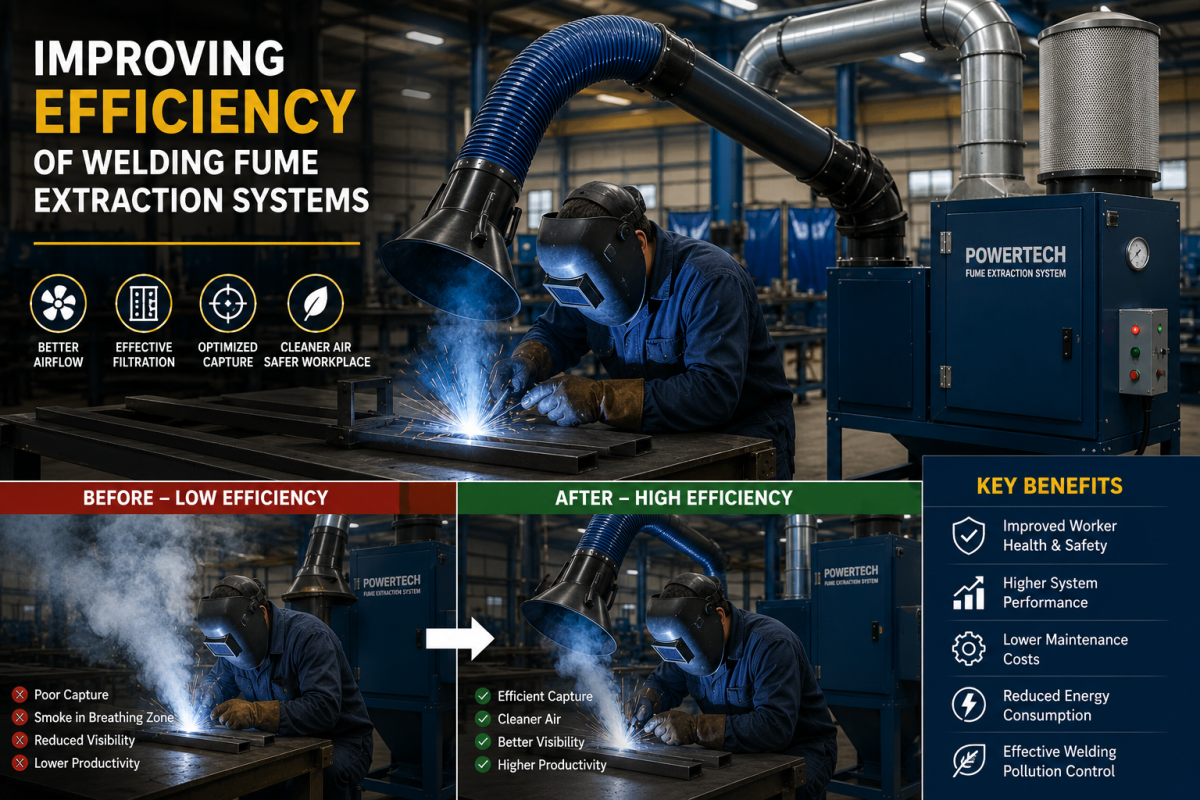
Installing a welding fume extraction system is only the first step toward maintaining clean and safe industrial environments. In many facilities, systems operate below their intended performance due to airflow imbalance, poor hood positioning, clogged filters, or improper maintenance practices. As a result, fumes escape into the workspace despite the presence of extraction equipment.
Improving the efficiency of a welding fume extractor requires a combination of proper engineering design, operational optimization, and preventive maintenance. Even small adjustments in airflow, duct layout, or extraction arm positioning can significantly enhance overall system performance.
An optimized approach to welding pollution control not only improves air quality but also reduces energy consumption and maintenance costs. With over 30 years of experience, Powertech has improved fume extraction system performance across fabrication shops, automotive manufacturing facilities, and heavy engineering industries through practical engineering-driven optimization strategies.
Key Takeaways
- Proper source capture is the most important factor in welding fume extraction efficiency.
- Airflow balancing and duct optimization significantly improve system performance.
- Regular maintenance prevents efficiency loss over time.
- Optimized systems improve both air quality and energy efficiency.
The Problem: Reduced System Efficiency
Many extraction systems gradually lose performance due to operational and maintenance issues.
Causes
- Incorrect extraction arm positioning
- Insufficient airflow at capture points
- Poor duct design and pressure losses
- Clogged or overloaded filters
- Lack of preventive maintenance
Workplace Impact
- Visible welding fumes in the workspace
- Reduced visibility and operator comfort
- Higher energy consumption
- Increased downtime and maintenance costs
Safety Risks
According to the Occupational Safety and Health Administration (OSHA), inadequate welding ventilation may expose workers to hazardous airborne contaminants.
The National Institute for Occupational Safety and Health (NIOSH) recommends proper ventilation and source capture methods for effective welding fume control.
Technical Explanation: How to Improve System Efficiency
Step 1: Optimize Source Capture
Effective source capture is the foundation of system efficiency.
Best Practices
- Position extraction arms 150–300 mm from the arc
- Align hood with rising fume direction
- Avoid airflow obstruction by the operator
Proper positioning improves capture without increasing airflow.
Step 2: Balance Airflow Across the System
Uneven airflow reduces performance in multi-point systems.
Optimization Methods
- Adjust dampers
- Measure airflow at all stations
- Ensure consistent suction levels
Balanced systems deliver more reliable performance.
Step 3: Improve Duct Design
Poor duct layouts increase pressure losses.
Recommended Improvements
- Reduce sharp bends
- Maintain proper duct velocity (12–17 m/s)
- Shorten unnecessary duct runs
Better duct design improves airflow efficiency.
Step 4: Maintain Filtration Systems
Filter condition directly affects airflow and extraction performance.
Maintenance Actions
- Monitor pressure drop
- Replace clogged filters
- Clean filters and ducting regularly
Delayed maintenance is a major cause of performance decline.
Step 5: Monitor System Performance
Continuous monitoring helps identify problems early.
Parameters to Monitor
- Airflow
- Static pressure
- Filter pressure drop
- Fan performance
Data-driven maintenance improves reliability.
Key Parameters Affecting Efficiency
| Parameter | Recommended Range | Impact |
|---|---|---|
| Hood distance | 150 – 300 mm | Source capture efficiency |
| Capture velocity | 0.5 – 1.5 m/s | Fume control effectiveness |
| Duct velocity | 10 – 15 m/s | Prevents dust settling |
| Filter pressure drop | Within design range | Maintains airflow |
| Airflow balance | Uniform across stations | Consistent performance |
Practical Industrial Applications
Fabrication Shops
- Frequent repositioning of extraction arms
- Need for flexible airflow balancing
Automotive Manufacturing
- Centralized systems requiring precise balancing
- Robotic welding with consistent airflow demands
Maintenance Workshops
- Portable systems dependent on operator positioning
Heavy Engineering
- High particulate load requiring optimized filtration and airflow
Expert Insight
From Powertech’s field experience, one of the most effective ways to improve welding fume extraction efficiency is through system optimization rather than equipment replacement.
Key observations:
- Poor positioning often causes greater efficiency loss than insufficient airflow
- Regular airflow measurements reveal hidden performance issues
- Preventive maintenance significantly improves long-term performance
In several installations, optimizing airflow distribution and hood positioning improved system efficiency without increasing fan capacity.
By optimizing hood positioning, balancing airflow, improving duct design, and maintaining filters regularly.
No. Proper source capture and system design are equally important.
Due to clogged filters, airflow imbalance, and lack of maintenance.
Regular inspections and airflow measurements are recommended.
Yes. Many systems can be optimized through design corrections and maintenance.
Improving welding fume extraction efficiency requires a comprehensive approach that combines proper source capture, optimized airflow, effective filtration, and preventive maintenance. By focusing on fume extraction system performance and implementing engineering-driven improvements, industries can achieve better welding pollution control, improved air quality, and lower operational costs. With decades of experience, Powertech continues to help industries optimize welding ventilation systems for reliable, efficient, and long-term performance.