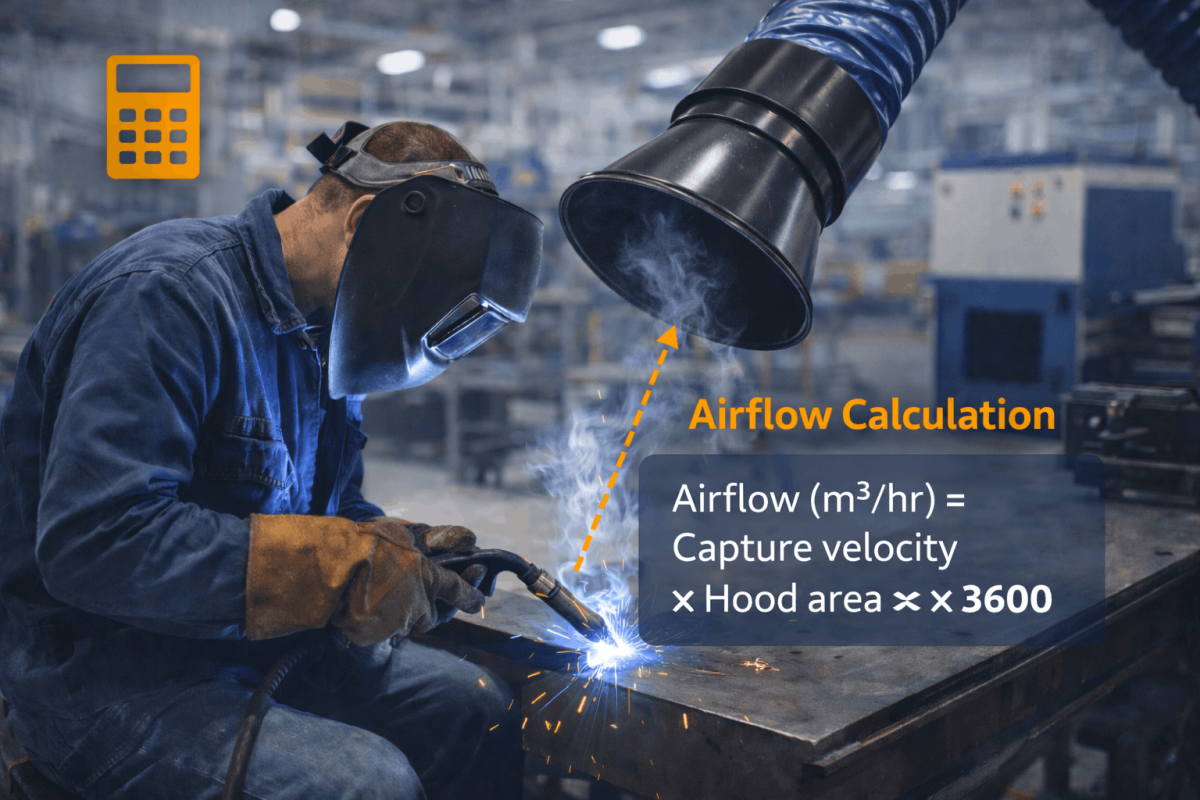
Welding fume extractor hood positioned near the weld to capture fumes during metal welding operations.

Welding Fume Extractor Sizing: How to Calculate Airflow Requirements

Why Correct Airflow Sizing Is Critical

A welding fume extractor works only when airflow matches the fume load. If airflow is too low, fumes escape into the workspace. If airflow is too high, energy use increases without added benefit.

Correct sizing ensures effective capture, stable performance, and lower operating cost.

What Determines Airflow Requirements

Type of Welding Process

Different welding processes generate different fume volumes. Higher heat input produces more fumes and needs higher airflow.

Number of Welding Stations

Each active station adds to the total airflow demand. Systems serving multiple stations must account for simultaneous operation.

Capture Distance

The farther the hood sits from the welding point, the more airflow is needed. Keeping the hood close reduces airflow demand.

Workplace Air Movement

Fans, open doors, and cross drafts push fumes away from the hood. This increases airflow requirements.

Basic Method to Estimate Airflow

  1. Decide the Capture Velocity

    Most welding applications require a capture velocity between 0.5 to 1.0 m/s at the fume source.

  2. Measure Hood Opening Area

    Calculate the open area of the suction hood in square meters.

  3. Calculate Airflow

    Use the formula:
    Airflow (m³/hr) = Capture velocity × Hood area × 3600
    This gives a basic airflow value for one welding station.

Adjustments for Real-World Conditions

Add Safety Margin

Add 20–30% extra airflow to account for losses in ducts and filters.

Account for Duct Length

Longer ducts increase resistance. This may require higher fan capacity.

Consider Simultaneous Welding

If multiple stations operate at the same time, total airflow must support all active points.

An experienced welding fume extractor manufacturer in Bangalore usually performs these calculations during system design.

Common Sizing Mistakes

Oversizing the System

Oversized systems waste energy and increase noise without improving capture.

Ignoring Hood Position

Poor positioning forces the system to compensate with higher airflow.

Assuming One Size Fits All

Each welding setup needs a specific airflow calculation.

Q&A: Welding Fume Extractor Airflow Sizing

Q1: Can I use a standard airflow value for all welders?

No. Airflow depends on welding intensity, hood size, and layout.

Q2: Does higher airflow always improve fume capture?

No. Correct hood placement is more effective than excessive airflow.

Q3: Should airflow change for portable extractors?

Yes. Portable units need proper sizing based on their working distance.

Q4: Who should calculate airflow requirements?

A qualified welding fume extractor manufacturer in Bangalore should assess airflow needs based on site conditions.


Conclusion

Correct airflow sizing is essential for welding fume extraction. It ensures fumes get captured before spreading while keeping energy use under control. Calculating airflow based on capture velocity, hood size, and layout leads to reliable performance.

A well-sized welding fume extractor protects workers, improves air quality, and supports efficient operations.
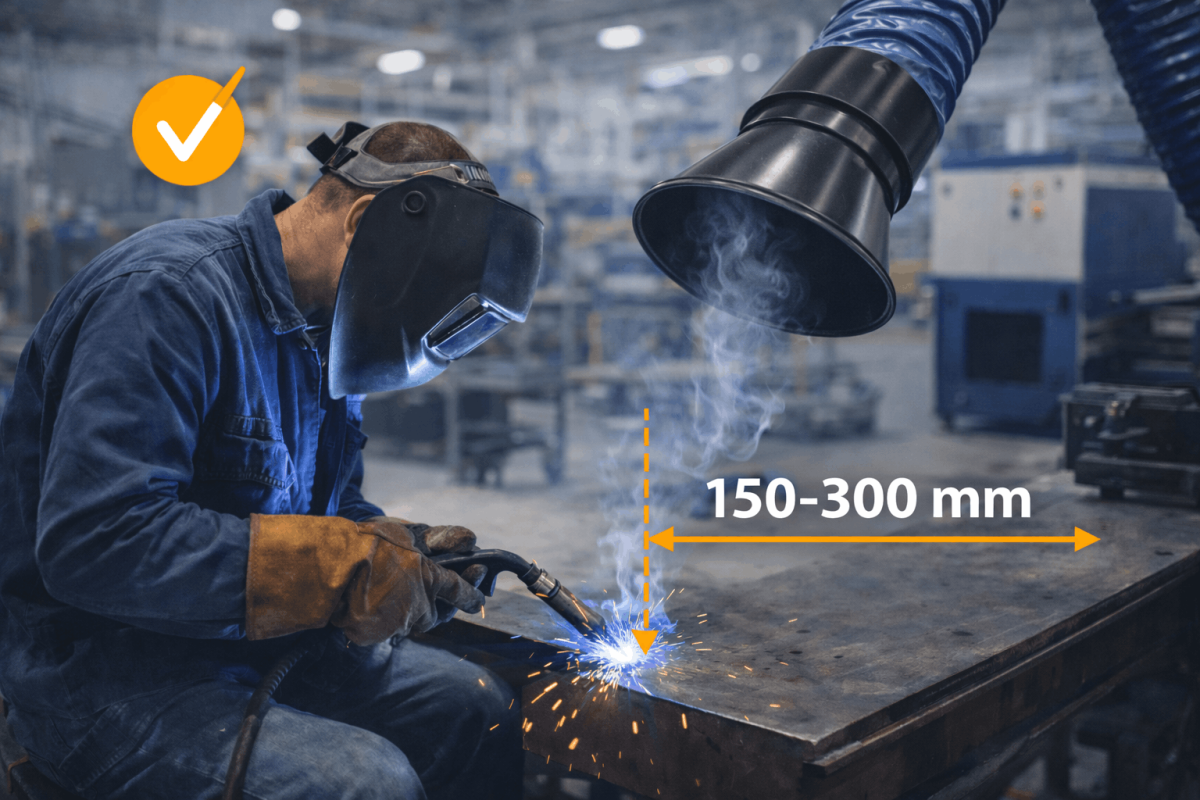

Welding fume extractor hood positioned 150–300 mm from the welding point to capture fumes effectively.

How to Position a Welding Fume Extractor for Maximum Capture Efficiency

Why Positioning Matters More Than System Size

Even the best welding fume extractor will fail if it is positioned incorrectly. Welding fumes rise fast and spread quickly. If the capture point sits too far from the source, fumes enter the breathing zone before extraction begins.

Correct positioning improves fume capture, protects workers, and reduces load on the extraction system.

How Welding Fumes Behave

Upward Movement

Welding fumes are hot. They rise immediately after formation. This makes timing and distance critical.

Rapid Dispersion

Once fumes spread, they become harder to capture. Nearby airflow from fans or movement makes this worse.

Understanding this behavior helps place the extractor correctly.

Ideal Distance Between the Fume Source and Extractor

Keep It Close

The suction hood should sit as close as possible to the welding arc without interfering with work.

Recommended Range

In most cases, positioning the hood 150–300 mm from the fume source gives effective capture.

Greater distance reduces suction strength at the arc.

Correct Angle for Maximum Capture

Avoid Directly Above the Arc

Placing the hood directly above the weld can disturb shielding gas and affect weld quality.

Side or Rear Positioning

Position the hood slightly to the side or behind the weld path. This allows fumes to flow naturally into the hood.

Using Flexible Extraction Arms Effectively

Lock the Arm in Place

A loose arm drifts during welding and loses capture efficiency. Always secure joints after positioning.

Avoid Sharp Bends

Smooth arm movement maintains airflow and suction strength.

Systems designed by an experienced welding fume extractor manufacturer in Bangalore usually allow easy and stable arm positioning.

Common Positioning Mistakes to Avoid

Too Far from the Source

Distance weakens capture and allows fumes to spread.

Blocking Operator Movement

If the hood interferes with work, operators move it away. This reduces effectiveness.

Ignoring Airflow Direction

Cross drafts push fumes away from the hood. Always check surrounding airflow.

Q&A: Welding Fume Extractor Positioning

Q1: Should the extractor always be above the weld?
No. Side or rear positioning usually works better.

Q2: Can one extractor arm serve two welders?
Only if fumes are light and positioning stays close for both stations.

Q3: Does better positioning reduce energy use?
Yes. Efficient capture reduces the need for higher airflow.

Q4: Who can help with layout planning?
A qualified welding fume extractor manufacturer in Bangalore can assess layout and recommend optimal positioning.

Conclusion

Correct positioning decides how well a welding fume extractor performs. Keeping the hood close, using the right angle, and avoiding airflow disturbance improves capture efficiency.

Good positioning protects workers, improves air quality, and ensures the extraction system performs as intended.

Soldering workstation with visible flux fumes being captured by a soldering fume extractor during PCB assembly.

Common Flux Types in Soldering and Their Impact on Indoor Air Quality

Why Flux Choice Matters for Air Quality

Flux plays a critical role in soldering. It cleans metal surfaces and helps solder flow correctly. However, when flux heats up, it releases fumes. These fumes directly affect indoor air quality, especially in electronics assembly areas with continuous soldering.

Understanding different flux types helps facilities control exposure and choose the right fume extraction approach.

What Happens When Flux Is Heated

Fume Generation

During soldering, flux burns and releases smoke made of fine particles and gases. These fumes rise quickly and stay close to the operator’s breathing zone.

Accumulation in Enclosed Areas

Electronics assembly lines often operate indoors with limited ventilation. Without proper extraction, fumes build up and spread to nearby stations.

Common Flux Types Used in Soldering

Rosin-Based Flux

Rosin flux is widely used in electronics soldering. When heated, it releases thick white fumes that cause eye and throat irritation. Long-term exposure affects breathing comfort.

Water-Soluble Flux

This flux type produces fumes that contain active chemicals. These fumes spread quickly and require effective source capture to prevent buildup.

No-Clean Flux

No-clean flux leaves minimal residue, but it still releases fumes during heating. Operators often underestimate its impact because the smoke appears lighter.

Activated Flux

Activated flux types clean aggressively but release stronger fumes. These fumes affect air quality faster than standard fluxes.

Impact of Flux Fumes on Indoor Air Quality

Breathing Discomfort

Operators inhale fumes directly during soldering. This leads to coughing, throat irritation, and shortness of breath over time.

Eye and Skin Irritation

Flux fumes irritate eyes and exposed skin, especially during long shifts.

Reduced Work Comfort

Poor air quality causes fatigue and reduces focus. This affects productivity and soldering accuracy.

Surface Contamination

Fumes settle on circuit boards, tools, and work surfaces. This increases cleaning effort and rework risk.

How a Soldering Fume Extractor Controls Flux Fumes

Source-Level Capture

A soldering fume extractor captures fumes directly at the soldering point. This prevents fumes from entering the breathing zone.

Consistent Air Quality

Continuous extraction keeps air quality stable across all soldering stations.

Cleaner Workstations

Effective fume control reduces residue buildup on boards and equipment.

A reliable soldering fume extractor manufacturer in Bangalore designs systems suited for different flux types and soldering densities.

Q&A: Flux and Air Quality in Soldering

Q1: Do all flux types produce harmful fumes?
Yes. All flux types release fumes when heated, even no-clean flux.

Q2: Is general ventilation enough for soldering fumes?
No. Ventilation only dilutes fumes. Extraction removes them at the source.

Q3: Does flux type affect extractor selection?
Yes. Stronger flux fumes require efficient source capture and filtration.

Q4: When should a soldering fume extractor be mandatory?
Any indoor soldering operation with repeated or continuous soldering needs extraction.

Conclusion

Different flux types produce different levels of fumes, but all impact indoor air quality. In high-density electronics assembly, these fumes build up quickly and affect health, comfort, and product quality.Using a soldering fume extractor ensures fumes stay away from workers and sensitive components. Effective fume control starts with understanding flux behavior and capturing fumes at the source.

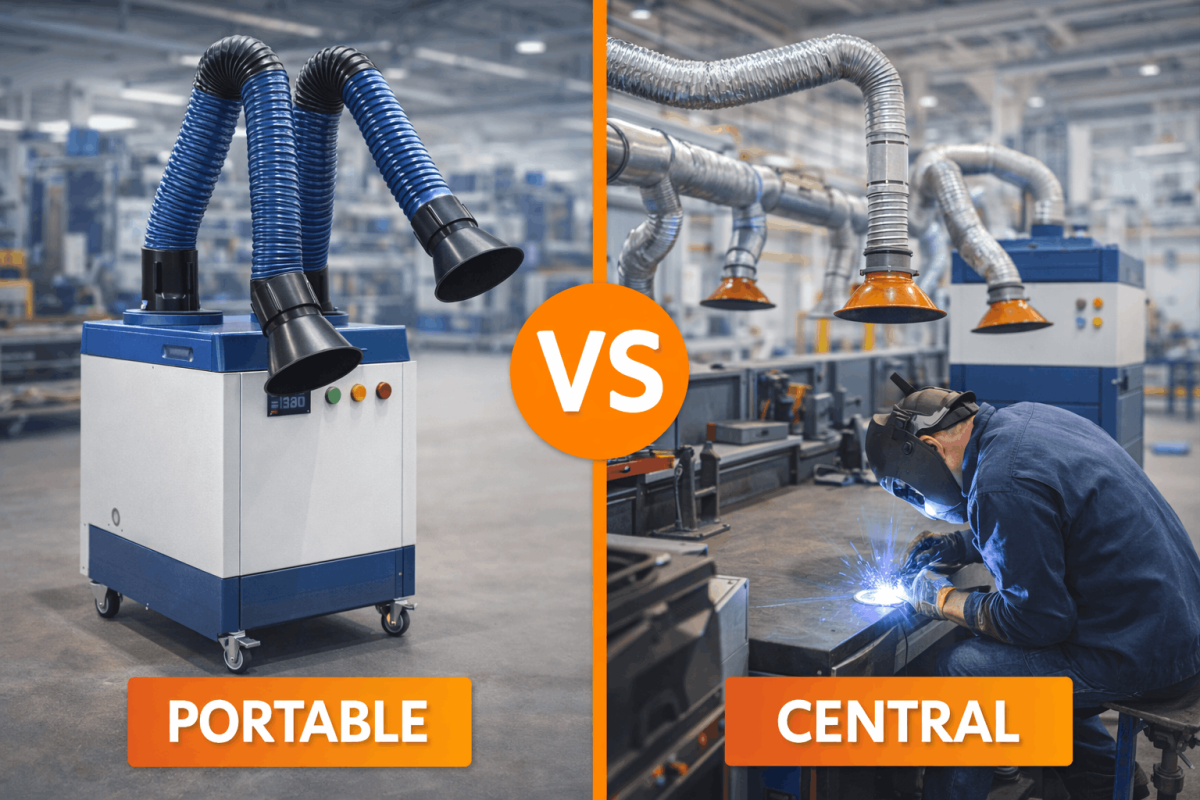
Portable welding fume extractor compared with a central welding fume extraction system inside an industrial workshop.

Portable vs Central Welding Fume Extractors: Which One Fits Your Facility?

Why Choosing the Right Welding Fume Extractor Matters

Welding fumes pose serious health risks when they remain in the workspace. A welding fume extractor removes these fumes before workers inhale them. However, not all facilities need the same type of system.

The two common options are portable welding fume extractors and central welding fume extraction systems. Each works well in specific conditions. Choosing the right one depends on layout, number of stations, and production style.

What Is a Portable Welding Fume Extractor?

How It Works

A portable welding fume extractor is a self-contained unit. It usually has wheels and one or two flexible suction arms. Operators move it close to the welding point to capture fumes directly.

Best Suited For

  • Small workshops
  • Job shops
  • Repair and maintenance areas
  • Low to medium number of welding stations

Key Advantages

  • Easy to move
  • No fixed ducting required
  • Lower installation cost
  • Flexible use across different work areas

Limitations

  • Limited capacity for large facilities
  • Requires manual repositioning
  • Not ideal for continuous high-volume welding

What Is a Central Welding Fume Extraction System?

How It Works

A central system uses a single high-capacity extractor connected to multiple welding stations through ducting. Each station has a hood or suction arm connected to the system.

Best Suited For

  • Large production floors
  • Fixed welding stations
  • High-volume or multi-shift welding
  • Facilities with consistent layouts

Key Advantages

  • Handles multiple stations at once
  • Stable airflow and suction
  • Minimal operator intervention
  • Cleaner overall shop environment

Limitations

  • Higher initial installation cost
  • Requires duct planning
  • Less flexible once installed

Key Factors to Consider When Choosing

Number of Welding Stations

Few stations benefit from portable units. Many stations usually need a central system.

Layout Flexibility

If workstations move often, portable extractors work better. Fixed layouts suit central systems.

Production Volume

High-duty welding requires consistent extraction, which central systems handle better.

Maintenance Planning

Central systems allow planned maintenance at one point. Portable units need individual attention.

Q&A: Portable vs Central Welding Fume Extractors

Q1: Can portable welding fume extractors serve two stations?
Yes. Some models support twin extractor arms, depending on fume load.

Q2: Do central systems consume more power?
Not always. Well-designed systems use optimized airflow to reduce energy use.

Q3: Is a portable system suitable for continuous production?
It works for limited production but may struggle under heavy, continuous loads.

Q4: Who can help choose the right system?
An experienced welding fume extractor manufacturer in Bangalore can assess layout, welding type, and airflow needs.

Conclusion

Portable and central welding fume extractors serve different needs. Portable units offer flexibility and lower setup cost. Central systems provide consistent extraction for large and busy facilities.

The right choice depends on how many stations you have, how often layouts change, and how intensive the welding process is. Selecting the correct system ensures clean air, better safety, and stable operations.

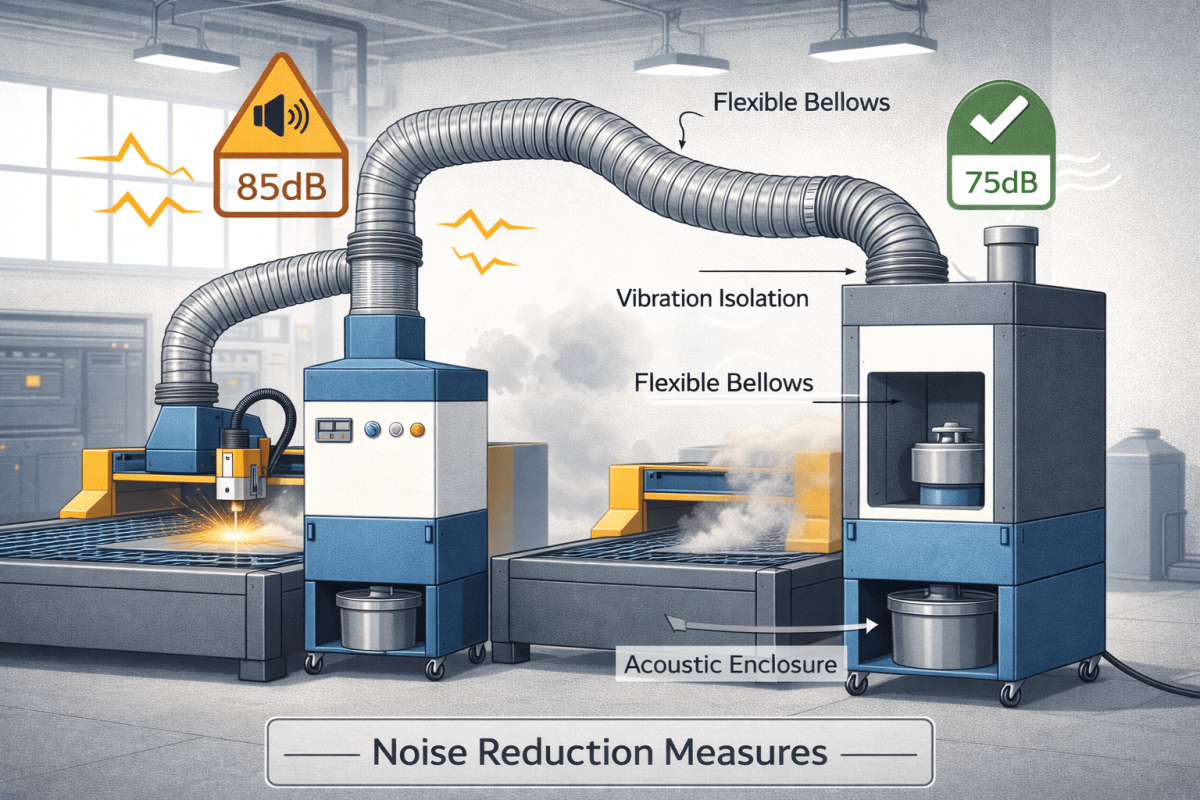
Air pollution control system with noise reduction features operating in an industrial workshop environment.

Noise Levels in Air Pollution Control Systems and How to Reduce Them

Why Noise Control Matters in Industrial Workspaces

Air pollution control systems improve air quality, but they can also introduce noise into the work environment. High noise levels affect worker comfort, concentration, and long-term hearing health. In many facilities, excessive equipment noise also leads to complaints and safety concerns.

Understanding where noise comes from and how to control it helps industries create safer and more productive workplaces.

Common Sources of Noise in Air Pollution Control Systems

1. Fans and Blowers

High-speed fans generate most of the noise in fume extractors, dust collectors, and mist collectors. Poor fan selection or imbalance increases sound levels.

2. Airflow Turbulence

Sharp bends in ducts, sudden diameter changes, and improper hood design cause turbulence. Turbulence increases both noise and energy loss.

3. Motor Vibration

Motors mounted without proper isolation transfer vibration to the structure. This vibration amplifies noise across the shop floor.

4. Worn or Clogged Filters

Blocked filters increase resistance. Fans work harder to maintain airflow, which raises noise output.

Typical Noise Levels to Watch For

  • Comfortable industrial noise: below 75 dB
  • Caution zone: 75–85 dB
  • Harmful exposure: above 85 dB

Many regulations recommend limiting continuous exposure above 85 dB. Air pollution control systems should operate well below this level where possible.

How to Reduce Noise in Air Pollution Control Systems

1. Use Low-Noise Fan Design

Backward-curved fans and properly sized blowers produce less noise while maintaining airflow.

2. Improve Duct Design

  • Reduce sharp bends
  • Maintain smooth airflow paths
  • Use correct duct sizing

Better duct design lowers turbulence and noise.

3. Add Vibration Isolation

Rubber mounts, spring isolators, and flexible connectors prevent vibration from spreading to the structure.

4. Maintain Filters Regularly

Clean filters reduce pressure drop and keep fans operating at normal speeds.

5. Use Acoustic Enclosures or Silencers

Enclosures around blowers and inline silencers help absorb sound without affecting airflow.

Systems designed by an experienced fume extractor manufacturer in Bangalore often include noise reduction features at the design stage.

Balancing Noise Control and Extraction Performance

Reducing noise should not reduce extraction efficiency. The goal is to control sound while maintaining proper airflow and suction. Poor noise control methods, such as choking airflow, reduce system performance and should be avoided.

Well-designed systems achieve both clean air and acceptable noise levels.

Q&A: Noise in Air Pollution Control Systems

Q1: Are air pollution control systems always noisy?
No. Properly designed systems operate at safe noise levels.

Q2: Can noise increase over time?
Yes. Poor maintenance, worn bearings, and clogged filters increase noise.

Q3: Does higher airflow always mean higher noise?
Not always. Correct fan selection and duct design allow high airflow with low noise.

Q4: Who can help design low-noise extraction systems?
A qualified fume extractor manufacturer in Bangalore can design systems that balance airflow, efficiency, and noise control.

Conclusion

Noise from air pollution control systems affects worker comfort and safety if not managed properly. Most noise issues come from fan design, duct layout, vibration, and poor maintenance.

By focusing on proper system design, regular upkeep, and sound control measures, industries can maintain clean air without adding harmful noise to the workplace.