Industrial Air Pollution Control Systems in Manufacturing

Introduction

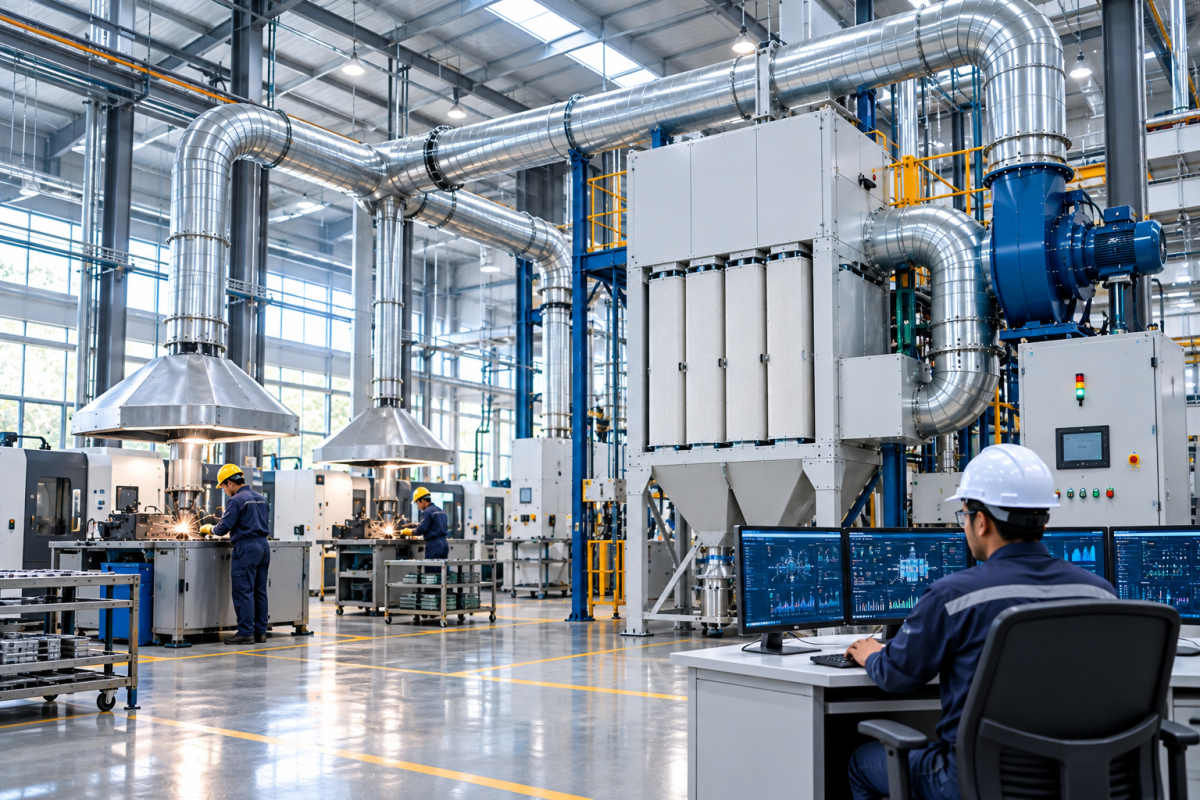
Manufacturing processes can release a wide range of airborne contaminants, including dust, welding fumes, oil mist, coolant mist, smoke, vapours, and fine particulate matter. If these contaminants are not effectively controlled, they can affect workplace air quality, contaminate machinery, increase maintenance requirements, and create challenging operating conditions.

An effective industrial air pollution control strategy captures contaminants as close as possible to their source and removes them through appropriately selected filtration or separation equipment.

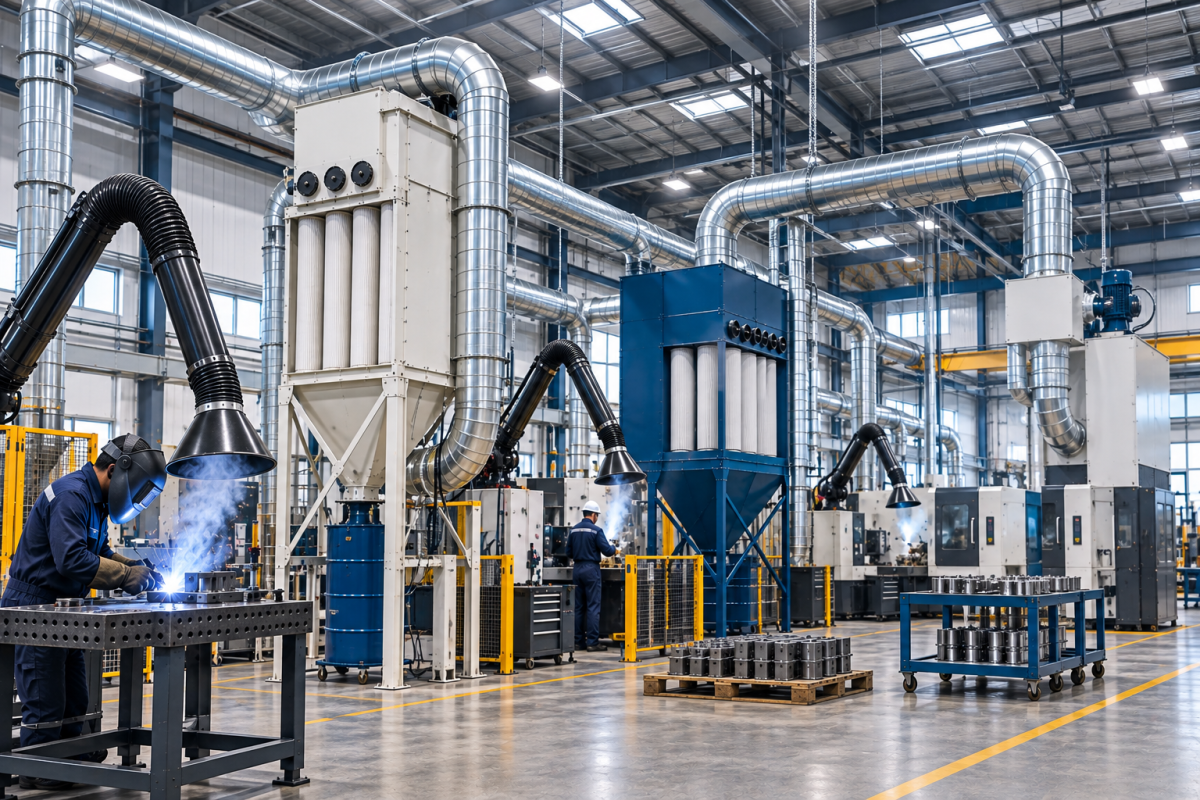
For manufacturing facilities, this may involve industrial air filtration systems, local exhaust ventilation, dust collectors, mist collectors, fume extraction systems, or a combination of technologies.

The right solution depends on the contaminant, process, airflow requirements, facility layout, and operating conditions.

Key Takeaways

  1. Different manufacturing processes generate different types of airborne contaminants.
  2. Source capture is generally more effective than attempting to clean contaminated air after it has dispersed.
  3. Industrial air filtration systems should be selected based on the specific contaminant.
  4. Dust, fumes, mist, and vapours require different collection and filtration technologies.
  5. Properly designed industrial ventilation systems improve contaminant control and workplace air quality.
  6. An integrated factory air pollution control strategy can reduce equipment contamination, maintenance, and housekeeping requirements.

What Is Industrial Air Pollution Control?

Industrial air pollution control refers to the systems and engineering practices used to capture, filter, separate, or otherwise control airborne contaminants generated by industrial processes.

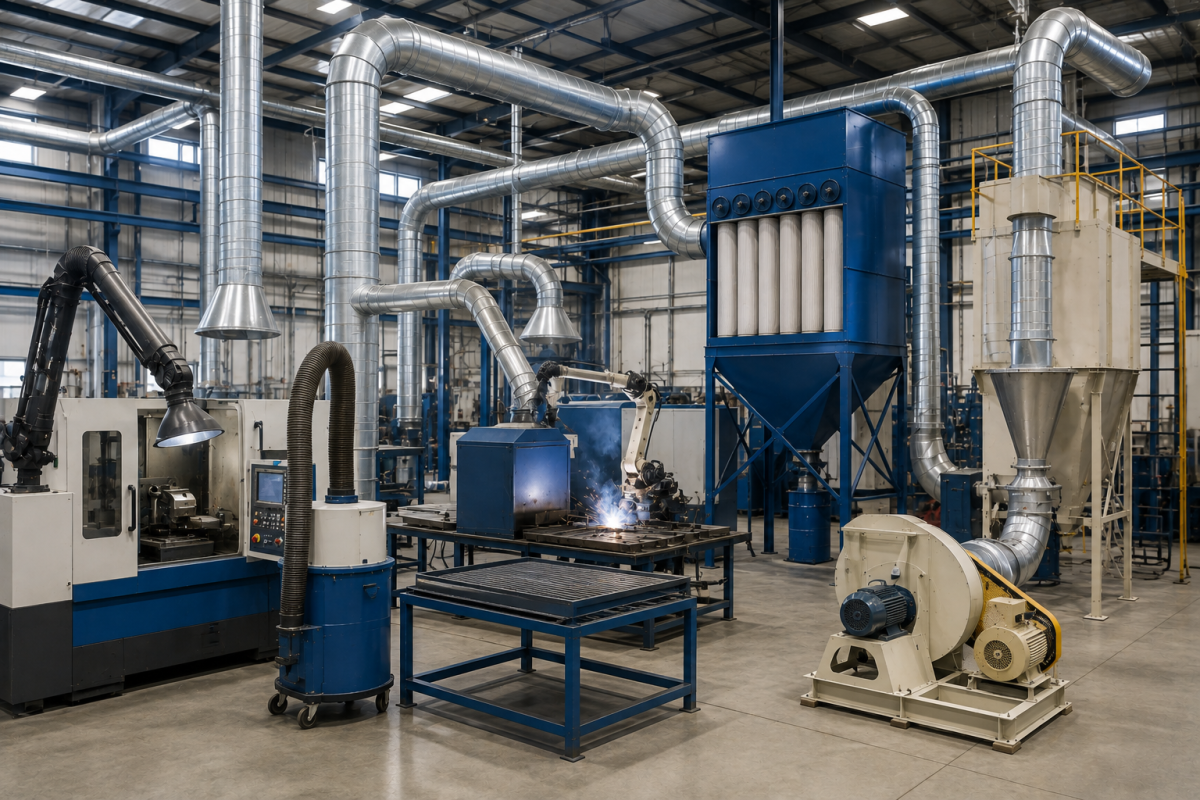
A typical system may include:

  1. Source-capture hood or enclosure
  2. Extraction ductwork
  3. Filtration or separation equipment
  4. Industrial blower
  5. Dust or contaminant discharge system
  6. Monitoring and control equipment

The objective is to prevent contaminants from spreading into the production environment while maintaining the required airflow at the source.

Common Air Pollutants in Manufacturing

Different manufacturing processes produce different contaminants.

Dust

Generated during:

  1. Grinding
  2. Cutting
  3. Sanding
  4. Polishing
  5. Crushing
  6. Material handling
  7. Powder processing

Dust collectors are typically used to capture and filter these particles.

Welding Fumes

Welding and thermal cutting can generate fine particulate fumes and gases.

Source-capture welding fume extractors can remove these contaminants close to the welding operation.

Oil and Coolant Mist

CNC machining and metalworking operations can generate airborne oil and coolant droplets.

Mist collectors are designed to capture these aerosols before they spread throughout the machine shop.

Smoke and Fine Particles

Processes involving heating, thermal treatment, soldering, and other high-temperature operations can produce smoke and fine particulate emissions.

The filtration system should be selected according to the characteristics of the contaminant.

Why Source Capture Is Important

One of the fundamental principles of factory air pollution control is to capture contaminants before they disperse.

Consider a grinding machine generating fine metal dust.

If an extraction hood is positioned close to the grinding operation, the dust can be captured almost immediately.

If the facility instead relies on general room ventilation, the dust can spread throughout the workspace before eventually reaching the filtration system.

Source capture generally provides:

  1. Better contaminant control
  2. Lower required airflow
  3. Reduced workplace contamination
  4. Less equipment fouling
  5. Lower housekeeping requirements
  6. More targeted extraction

Types of Industrial Air Filtration Systems

There is no single filtration technology suitable for every manufacturing application.

1. Baghouse Dust Collectors

Baghouse systems use fabric filter bags to separate dust particles from an air stream.

They are commonly used for applications involving:

  1. High dust loading
  2. Grinding
  3. Material handling
  4. Mineral processing
  5. Large manufacturing operations

2. Cartridge Dust Collectors

Cartridge collectors use pleated filter elements that provide a large filtration surface within a relatively compact system.

They can be suitable for many fine, dry particulate applications.

3. Mist Collectors

Mist collectors remove airborne oil and coolant droplets generated during machining.

They are particularly relevant to:

  1. CNC machining
  2. Turning
  3. Milling
  4. Grinding
  5. Metalworking

Powertech’s MistKiller range is designed for industrial oil and coolant mist extraction applications.

4. Welding Fume Extractors

Welding fume extraction systems capture fumes directly at the welding source.

Depending on the application, systems may use:

  1. Flexible extraction arms
  2. Portable extractors
  3. Centralized extraction
  4. Source-capture hoods
  5. Specialized extraction arrangements

Powertech’s FumeKiller systems are designed for source-capture welding fume extraction.

5. Multi-Stage Filtration

Some industrial processes require more than one filtration stage.

A system may combine:

  1. Pre-filtration
  2. Particle filtration
  3. Fine filtration
  4. Gas or vapour filtration

The configuration depends on the contaminants and required air quality.

Industrial Ventilation Systems vs Local Exhaust

Industrial ventilation systems generally fall into two broad categories.

General or Dilution Ventilation

General ventilation replaces or dilutes contaminated air throughout a facility.

It can help manage overall environmental conditions but may not effectively control contaminants at their source.

Local Exhaust Ventilation

Local exhaust captures contaminants directly at the point where they are generated.

For concentrated industrial emissions, local exhaust is generally the preferred primary control strategy.

The two approaches can be used together where appropriate.

Designing a Factory Air Pollution Control System

A successful system should be designed around the actual manufacturing process.

Step 1: Identify Contaminant Sources

Determine where dust, fumes, mist, smoke, or other pollutants are generated.

Step 2: Characterize the Contaminant

Consider:

  1. Particle size
  2. Concentration
  3. Temperature
  4. Moisture
  5. Chemical properties
  6. Density
  7. Combustibility
  8. Required filtration level

Step 3: Select the Capture Method

Determine whether the process requires:

  1. Enclosure
  2. Extraction hood
  3. Extraction arm
  4. Downdraft extraction
  5. Side-draft extraction
  6. Machine-integrated extraction

Step 4: Calculate Airflow

The required airflow depends on the capture method, source geometry, process conditions, and number of extraction points.

Step 5: Design the Ductwork

Duct diameter, length, bends, branches, and airflow velocity all affect system resistance and performance.

Step 6: Select the Filtration Technology

Choose the appropriate dust collector, mist collector, fume extractor, or multi-stage filtration system.

Step 7: Select the Blower

The blower should be capable of delivering the required airflow at the calculated system static pressure.

Factors That Affect System Performance

Even a high-quality filtration unit can underperform if the overall system is poorly designed.

Important factors include:

Hood Position

The extraction point should be located as close as practical to the contaminant source.

Airflow

Insufficient airflow can result in poor capture.

Static Pressure

The blower must overcome resistance from the hood, ductwork, filters, fittings, and exhaust arrangement.

Filter Condition

Loaded or damaged filters can affect airflow and filtration performance.

Ductwork

Leaks, blockages, poor sizing, and excessive bends can reduce system efficiency.

Maintenance

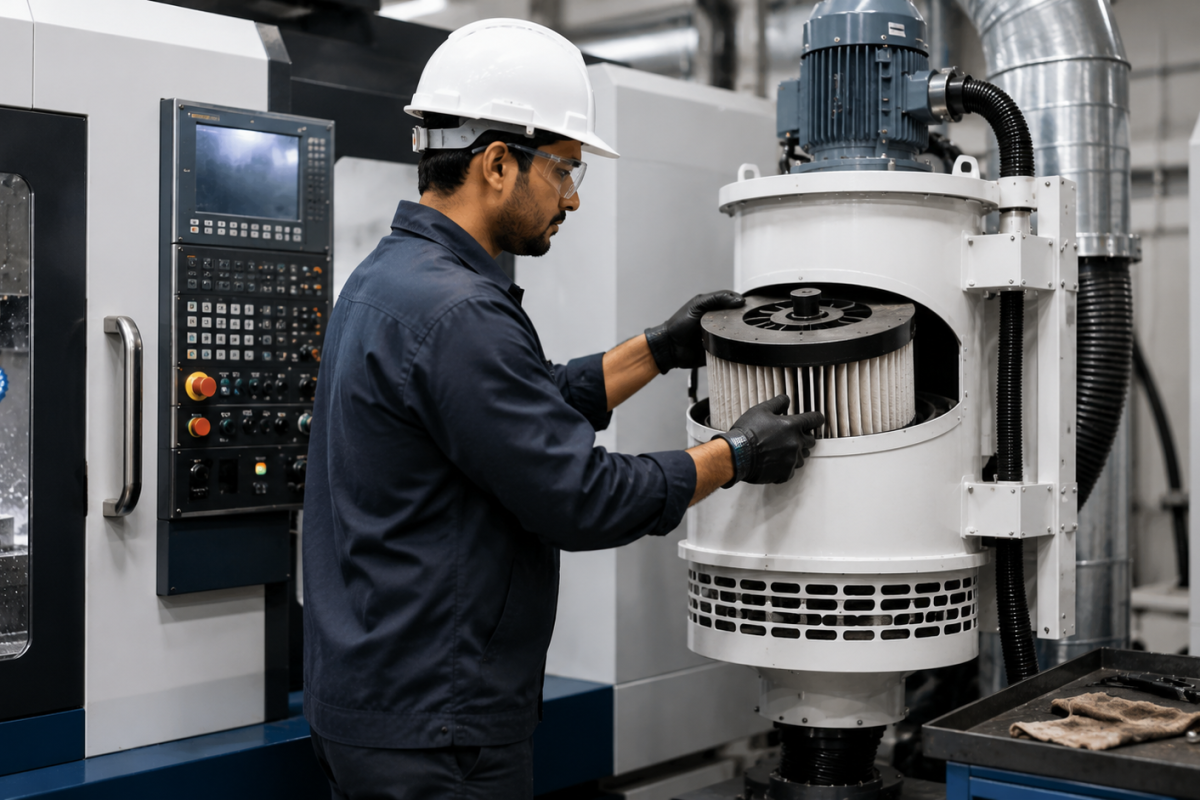
Regular inspection is essential for maintaining long-term performance.

Benefits of Effective Industrial Air Pollution Control

A properly designed system can provide several operational benefits.

Cleaner Production Areas

Source capture reduces the amount of airborne contamination circulating through the facility.

Reduced Equipment Contamination

Dust, oil mist, and fumes can settle on machinery, electrical systems, and production equipment.

Effective extraction helps minimize this buildup.

Lower Housekeeping Requirements

Reducing airborne contaminants can reduce the amount of material settling on floors, equipment, and surfaces.

Improved Product Quality

Contamination can affect certain manufacturing and finishing processes. Better air control can help maintain cleaner production conditions.

Reduced Maintenance

Less contamination around equipment can contribute to lower cleaning and maintenance requirements.

Improved Working Environment

Effective contaminant control contributes to cleaner workplace conditions and better overall environmental management.

Common Industrial Air Pollution Control Mistakes

Relying Only on General Ventilation

General ventilation cannot always control concentrated emissions effectively.

Installing the Wrong Filtration Technology

A filter designed for dry dust may not be appropriate for oil mist or chemical vapours.

Using Insufficient Airflow

Inadequate airflow can result in contaminants escaping the capture zone.

Poor Hood Positioning

Increasing the distance between the hood and source can significantly reduce capture effectiveness.

Ignoring Duct Design

Even an appropriately sized collector can perform poorly when connected to an inefficient duct network.

Neglecting Maintenance

Loaded filters, damaged seals, blocked ducts, and malfunctioning cleaning systems can gradually reduce performance.

Choosing the Right Industrial Air Pollution Control System

Before selecting equipment, manufacturers should evaluate:

FactorWhat to Consider
ContaminantDust, fume, mist, smoke, vapour
Particle sizeCoarse, fine, or ultrafine
SourceMachine, process, workstation, transfer point
AirflowRequired CFM
Static pressureTotal system resistance
Operating hoursIntermittent or continuous
Number of sourcesSingle or multiple
FiltrationRequired filtration technology
Plant layoutPortable, local, or centralized
MaintenanceFilter and equipment servicing
Future expansionAdditional machines or processes

Powertech’s Approach to Industrial Air Pollution Control

Powertech develops application-specific pollution control solutions rather than relying on a single filtration technology for every manufacturing process.

Depending on the application, the solution may involve:

  1. FumeKiller welding fume extraction systems
  2. MistKiller oil and coolant mist collectors
  3. DustBag industrial dust collection systems
  4. Local exhaust ventilation
  5. Centralized extraction systems
  6. Customized ductwork and filtration arrangements

The system can be engineered around the contaminant characteristics, production process, airflow requirements, plant layout, and operating conditions.

What is industrial air pollution control?

Industrial air pollution control involves capturing, filtering, separating, or otherwise controlling airborne contaminants generated by manufacturing and industrial processes.

What are industrial air filtration systems used for?

Industrial air filtration systems are used to remove contaminants such as dust, welding fumes, smoke, oil mist, coolant mist, and other airborne particles from industrial environments.

What is the difference between dust collection and air filtration?

Dust collection typically focuses on capturing and removing particulate generated by a specific process, while industrial air filtration can refer more broadly to systems that clean contaminated air, including dust, fumes, mist, and other pollutants.

Are industrial ventilation systems enough to control factory pollution?

General ventilation can support overall air management, but it may not provide effective source control for concentrated emissions. Local exhaust extraction is generally more effective for capturing contaminants at their source.

How do I choose an industrial air pollution control system?

The system should be selected based on the contaminant type, particle characteristics, process, required airflow, static pressure, operating conditions, filtration requirements, and facility layout.

Can one system control multiple industrial pollutants?

In some facilities, multiple contaminants can be managed through a coordinated system, but different pollutants may require different collection or filtration technologies. The system should be engineered based on the specific application.

Conclusion

Effective industrial air pollution control is an important part of modern manufacturing. Dust, welding fumes, oil mist, coolant mist, and other airborne contaminants require different approaches, making application-specific engineering essential. The most effective strategy is generally to capture contaminants close to their source and transport them through a properly designed extraction and filtration system. Industrial air filtration systems, local exhaust, and industrial ventilation systems can then work together to maintain cleaner production environments. For manufacturers, the right factory air pollution control solution can reduce airborne contamination, protect equipment, lower housekeeping requirements, and support more reliable production. Powertech provides engineered pollution control solutions across dust, mist, and welding fume applications, helping manufacturers select the appropriate technology for their specific processes.

Maintenance of Oil Mist Collectors

Introduction

An industrial mist collector is a critical component of any CNC machining or metalworking facility, continuously removing airborne oil and coolant mist to maintain clean air and protect equipment. However, even the most advanced mist collection systems require regular maintenance to ensure consistent performance, maximum collection efficiency, and long service life.

Proper mist collector maintenance not only improves extraction efficiency but also reduces unexpected downtime, extends equipment life, and lowers operating costs. Whether your facility uses a centrifugal, mechanical, or electrostatic system, scheduled oil mist collector maintenance is essential for maintaining reliable operation.

Routine CNC mist collector service also helps prevent contamination from affecting machine controls, electrical components, and production equipment while supporting overall industrial mist filtration maintenance programs.

With over 30 years of experience in industrial air pollution control, Powertech recommends preventive maintenance practices that keep mist collection systems operating at peak efficiency throughout their service life.

Key Takeaways

  1. Regular mist collector maintenance ensures consistent mist extraction performance.
  2. Preventive servicing reduces downtime and extends equipment life.
  3. Routine inspections help identify issues before they affect production.
  4. Clean collection systems improve airflow and extraction efficiency.
  5. A structured maintenance schedule lowers long-term operating costs.

Why Mist Collector Maintenance Is Important

Mist collectors operate continuously in demanding industrial environments.

Over time:

  1. Oil residue accumulates
  2. Mechanical components wear
  3. Airflow may decrease
  4. Drainage systems may become obstructed

Without routine maintenance, collection efficiency gradually declines.

Components That Require Regular Inspection

Collection Chamber

Inspect for:

  1. Oil accumulation
  2. Sludge deposits
  3. Drainage blockages

Regular cleaning prevents reduced collection efficiency.

Drain System

Ensure collected oil drains freely.

Blocked drains may allow liquid to accumulate inside the collector.

Motor Assembly

Check for:

  1. Unusual vibration
  2. Excessive noise
  3. Bearing wear
  4. Secure mounting

Reliable motor operation is essential for continuous extraction.

Fan and Impeller

Inspect for:

  1. Residue build-up
  2. Imbalance
  3. Wear
  4. Damage

Clean rotating components maintain proper airflow.

Ductwork

Inspect for:

  1. Loose connections
  2. Oil deposits
  3. Air leaks
  4. Physical damage

Well-maintained ductwork supports efficient airflow.

Electrical Components

Check:

  1. Wiring
  2. Control panels
  3. Switches
  4. Safety devices

Ensure all electrical systems operate correctly.

Recommended Maintenance Schedule

Daily

  1. Visual inspection
  2. Check for unusual noise
  3. Verify proper operation
  4. Confirm drainage

Weekly

  1. Clean accessible surfaces
  2. Inspect duct connections
  3. Check airflow indicators

Monthly

  1. Inspect motor and fan
  2. Examine electrical components
  3. Verify mounting hardware
  4. Check for oil build-up

Quarterly

  1. Perform comprehensive inspection
  2. Clean internal components
  3. Inspect ductwork thoroughly
  4. Verify extraction performance

Annually

  1. Complete preventive maintenance
  2. Replace worn components if required
  3. Test overall system performance
  4. Review operating conditions

Common Signs That Service Is Required

Watch for:

  1. Reduced extraction performance
  2. Oil residue around machines
  3. Increased airborne mist
  4. Excessive vibration
  5. Unusual motor noise
  6. Visible oil leaks
  7. Increased maintenance requirements

Early intervention prevents larger problems.

Best Practices for CNC Mist Collector Service

Follow Manufacturer Recommendations

Always perform maintenance according to the equipment manufacturer’s guidelines.

Maintain Maintenance Records

Record:

  1. Inspection dates
  2. Cleaning schedules
  3. Repairs
  4. Component replacement

Historical records help identify recurring issues.

Train Maintenance Personnel

Ensure technicians understand:

  1. Safe shutdown procedures
  2. Inspection methods
  3. Cleaning techniques
  4. Basic troubleshooting

Use Genuine Replacement Parts

Original components help maintain system performance and reliability.

Schedule Preventive Maintenance

Avoid waiting for equipment failure.

Preventive maintenance is significantly more cost-effective than emergency repairs.

Powertech’s Maintenance Philosophy

Powertech designs MistKiller centrifugal mist collectors with low-maintenance operation in mind.

Key features include:

  1. No disposable filter media
  2. Robust centrifugal separation
  3. Simple mechanical design
  4. Easy access for inspection
  5. Reliable continuous operation
  6. Reduced maintenance requirements

This minimizes downtime while maintaining consistently high mist collection efficiency.

Expert Insight

From Powertech’s experience, most mist collector failures are not caused by major component defects but by neglected preventive maintenance.

Facilities that follow structured inspection and servicing schedules consistently experience:

  1. Higher extraction efficiency
  2. Lower maintenance costs
  3. Longer equipment life
  4. Reduced production interruptions
  5. Improved workplace cleanliness

A proactive maintenance program protects both the mist collector and the machining equipment it serves.

How often should a mist collector be serviced?

Routine visual inspections should be performed daily, with more comprehensive maintenance carried out monthly, quarterly, and annually depending on operating conditions.

What happens if a mist collector is not maintained?

Poor maintenance can reduce airflow, decrease collection efficiency, increase contamination, and lead to higher operating costs.

Which components require the most frequent inspection?

Collection chambers, drain systems, motors, fans, ductwork, and electrical controls should all be inspected regularly.

Does maintenance improve extraction efficiency?

Yes. Clean components and unrestricted airflow help maintain optimal mist collection performance.

Are centrifugal mist collectors easier to maintain?

Generally, yes. Centrifugal systems like Powertech’s MistKiller require less routine maintenance because they operate without disposable filter media.

Why is preventive maintenance important?

Preventive maintenance identifies minor issues before they become costly failures, reducing downtime and extending equipment life.

Conclusion

Regular mist collector maintenance is essential for maintaining reliable oil mist extraction in modern machining facilities. Through planned oil mist collector maintenance, routine CNC mist collector service, and comprehensive industrial mist filtration maintenance, manufacturers can improve extraction efficiency, reduce downtime, and extend equipment life. By implementing a structured preventive maintenance program, facilities can maximize the performance of their mist collection systems while creating cleaner, safer, and more productive manufacturing environments. Powertech’s MistKiller centrifugal mist collectors are engineered for dependable, low-maintenance operation, helping manufacturers achieve long-term operational efficiency.

Industrial Mist Collectors for High-Speed Machining

Introduction

High-speed machining has transformed modern manufacturing by enabling faster production rates, improved precision, and superior surface finishes. Industries such as automotive, aerospace, medical device manufacturing, and precision engineering increasingly rely on high spindle speeds and high-pressure coolant systems to maximize productivity. However, these same processes generate significant volumes of airborne oil and coolant mist that must be effectively controlled.

An efficient industrial mist collector is essential for maintaining clean air in high-speed machining environments. During machining, cutting fluids become atomized into microscopic droplets that can remain suspended in the air, increasing contamination levels throughout the workshop. Without proper high speed machining mist extraction, these airborne contaminants can affect equipment, reduce workplace cleanliness, and compromise overall production efficiency.

Modern CNC oil mist collector systems are engineered to capture contaminants directly from machine enclosures before they escape into the workplace. Combined with effective machine shop air filtration, they help manufacturers improve indoor air quality, reduce maintenance, and create cleaner production environments.

With over 30 years of expertise in industrial air pollution control, Powertech’s MistKiller centrifugal mist collectors provide reliable, low-maintenance solutions for high-speed machining applications across a wide range of industries.

Key Takeaways

  1. High-speed machining produces large volumes of airborne coolant and oil mist.
  2. An industrial mist collector captures contaminants directly at the source.
  3. Proper mist extraction improves machine cleanliness and workplace air quality.
  4. CNC oil mist collectors reduce maintenance and extend equipment life.
  5. Engineered machine shop air filtration systems support safer and more efficient manufacturing.

Why High-Speed Machining Generates More Mist

As spindle speeds increase, machining fluids are subjected to greater centrifugal forces and turbulence.

This results in:

  1. Finer airborne droplets
  2. Greater mist concentration
  3. Longer suspension times
  4. Increased contaminant spread

Processes that commonly generate high levels of mist include:

  1. High-speed milling
  2. CNC turning
  3. Grinding
  4. Multi-axis machining
  5. Precision machining
  6. High-pressure coolant applications

Challenges in High-Speed Machining

Increased Airborne Contaminants

Microscopic oil and coolant droplets remain suspended in the air and can spread throughout the machine shop.

Equipment Contamination

Mist settles on:

  1. CNC controls
  2. Electrical cabinets
  3. Sensors
  4. Machine surfaces

leading to increased maintenance requirements.

Reduced Workplace Cleanliness

Airborne mist contributes to:

  1. Oily floors
  2. Dirty workstations
  3. Residue on equipment
  4. Increased housekeeping

Higher Maintenance Costs

Contamination can result in:

  1. More frequent machine cleaning
  2. Increased downtime
  3. Higher operating costs

How an Industrial Mist Collector Works

Step 1: Source Capture

Air containing oil and coolant mist is extracted directly from the CNC machine enclosure.

Step 2: Mist Separation

Powertech’s MistKiller uses centrifugal separation to remove airborne droplets from the airflow.

This process eliminates the need for disposable filter media in many machining applications.

Step 3: Coolant Recovery

Separated coolant drains into a collection chamber where it can often be recovered and reused depending on the system design.

Step 4: Clean Air Discharge

Cleaned air is safely discharged, improving workplace air quality while reducing airborne contamination.

Benefits of High Speed Machining Mist Extraction

Improved Air Quality

Capturing mist at the source significantly reduces airborne contaminants.

Cleaner Machines

Reduced residue accumulation protects CNC equipment and controls.

Lower Maintenance

Cleaner equipment requires less frequent servicing and cleaning.

Longer Equipment Life

Minimizing contamination helps extend the life of electrical and mechanical components.

Improved Productivity

Cleaner environments support more efficient machining operations.

CNC Oil Mist Collector Applications

Industrial mist collectors are commonly used in:

CNC Turning Centers

Continuous oil mist generation from rotating workpieces.

High-Speed Milling Machines

High spindle speeds create fine coolant aerosols.

Grinding Machines

Fine oil mist requires efficient source capture.

Multi-Axis Machining Centers

Multiple cutting operations increase airborne mist generation.

Precision Engineering

Maintaining clean machining environments improves product quality.

Machine Shop Air Filtration Best Practices

Effective air filtration should include:

  1. Source-capture mist extraction
  2. Proper machine enclosure sealing
  3. Routine equipment maintenance
  4. Regular inspection of extraction systems
  5. Correct mist collector sizing

General building ventilation alone should never be relied upon to control machining-generated oil mist.

Why Choose Powertech MistKiller

Powertech’s MistKiller centrifugal mist collectors are specifically engineered for demanding industrial machining environments.

Key Features

  1. High-efficiency centrifugal separation
  2. No disposable filter media
  3. Low maintenance
  4. Continuous operation
  5. Compact machine-mounted design
  6. Coolant recovery capability
  7. Energy-efficient operation

These features make MistKiller an excellent solution for modern high-speed machining applications.

Expert Insight

From Powertech’s experience, facilities that increase machining speeds often experience a sharp rise in airborne mist generation without realizing that existing extraction systems may no longer be adequate.

Rather than increasing general workshop ventilation, the most effective approach is to upgrade source-capture mist collection at individual machining centers. Properly engineered mist collectors consistently deliver cleaner equipment, improved operator comfort, lower maintenance costs, and better overall production efficiency.

Why does high-speed machining generate more mist?

Higher spindle speeds increase coolant atomization, producing finer airborne droplets that remain suspended for longer periods.

What is an industrial mist collector?

An industrial mist collector is a system that captures airborne oil and coolant mist directly from machining equipment before contaminants spread into the workplace.

Are CNC oil mist collectors suitable for high-speed machining?

Yes. Properly sized CNC oil mist collectors are specifically designed to handle the increased mist generation associated with high-speed machining operations.

Can mist collectors recover coolant?

Many centrifugal mist collectors separate coolant from the air stream, allowing the recovered liquid to be reused where appropriate.

Is general ventilation enough for machine shops?

No. Local source-capture mist extraction is far more effective than relying solely on general building ventilation for controlling machining-generated mist.

Which industries benefit from industrial mist collectors?

Automotive, aerospace, medical device manufacturing, precision engineering, heavy engineering, and general metalworking facilities all benefit from effective mist collection systems.

Conclusion

An industrial mist collector is an essential component of modern high-speed machining operations. As spindle speeds and coolant pressures continue to increase, effective high speed machining mist extraction becomes increasingly important for maintaining clean air, protecting valuable equipment, and improving workplace efficiency. By combining properly engineered CNC oil mist collector technology with effective machine shop air filtration, manufacturers can significantly reduce airborne contamination, lower maintenance costs, and create safer, more productive machining environments. With decades of experience in industrial air pollution control, Powertech’s MistKiller centrifugal mist collectors continue to provide reliable, energy-efficient mist extraction solutions for demanding manufacturing applications.

Dust Collectors for Grinding and Finishing Operations

Introduction

Grinding and finishing operations are among the most significant sources of airborne dust in industrial manufacturing. Processes such as surface grinding, deburring, polishing, buffing, and abrasive finishing generate large quantities of fine metal particles that can quickly disperse throughout a facility if not captured at the source. Installing an efficient dust collector for grinding is essential for maintaining clean air, protecting equipment, and improving overall manufacturing efficiency.

An engineered grinding dust extraction system removes airborne contaminants before they spread across the workshop. Effective metal grinding ventilation not only improves workplace air quality but also minimizes dust accumulation on machinery, electrical equipment, and finished products. Combined with high-performance industrial dust filtration, these systems help manufacturers create cleaner, safer, and more productive working environments.

With over 30 years of experience in industrial air pollution control, Powertech designs DustBag industrial dust collection systems specifically engineered for demanding grinding and finishing applications across a wide range of manufacturing industries.

Key Takeaways

  1. Grinding operations generate large quantities of fine airborne dust.
  2. Source-capture dust collectors are more effective than general ventilation.
  3. Proper grinding dust extraction protects machinery and improves air quality.
  4. Industrial dust filtration reduces maintenance and housekeeping costs.
  5. Engineered dust collection systems improve productivity and workplace safety.

Why Grinding Operations Generate Large Amounts of Dust

Grinding removes material through high-speed abrasion. As grinding wheels contact the workpiece, microscopic particles are released into the air.

The amount of dust generated depends on several factors, including:

  1. Material being processed
  2. Grinding wheel speed
  3. Feed rate
  4. Abrasive type
  5. Surface finishing requirements

Without proper extraction, these particles remain suspended in the workplace before settling on equipment and surrounding surfaces.

Common Grinding and Finishing Applications

Industrial dust collectors are commonly used for:

Surface Grinding

Produces continuous fine metallic dust.

Belt Grinding

Generates airborne particles during material removal.

Deburring

Removes sharp edges while creating fine dust.

Polishing

Produces extremely fine particulate matter.

Buffing

Creates airborne polishing compounds and metal particles.

Abrasive Finishing

Generates dust from both abrasive media and processed materials.

Challenges of Grinding Dust

Poor Air Quality

Fine particles remain airborne for extended periods, reducing overall workplace cleanliness.

Equipment Contamination

Dust accumulates on:

  1. CNC machines
  2. Electrical cabinets
  3. Automation systems
  4. Precision instruments

Product Contamination

Airborne dust may settle on finished components before packaging or assembly.

Increased Housekeeping

Dust accumulation requires frequent cleaning of machines, floors, and production areas.

Higher Maintenance Costs

Contaminated equipment often requires more frequent servicing and maintenance.

How a Dust Collector for Grinding Works

Step 1: Source Capture

Extraction hoods capture dust directly from grinding equipment.

Step 2: Air Conveyance

Dust-laden air is transported through engineered ductwork.

Step 3: Industrial Dust Filtration

High-efficiency filter media separate airborne particles from the airflow.

Step 4: Dust Collection

Collected dust is stored in hoppers or collection bins for disposal or recycling.

Step 5: Clean Air Discharge

Filtered air is safely discharged or recirculated according to plant requirements.

Benefits of Grinding Dust Extraction

Cleaner Work Environment

Source capture significantly reduces airborne dust.

Improved Equipment Reliability

Cleaner machinery experiences lower contamination and maintenance requirements.

Better Product Quality

Reduced airborne dust minimizes contamination during finishing operations.

Lower Operating Costs

Efficient dust extraction decreases housekeeping and maintenance expenses.

Improved Productivity

Cleaner facilities support smoother production and improved operator efficiency.

Metal Grinding Ventilation Best Practices

To maximize performance:

  1. Capture dust as close to the grinding point as possible.
  2. Maintain sufficient airflow throughout the duct system.
  3. Inspect filters regularly.
  4. Prevent air leaks in ductwork.
  5. Schedule preventive maintenance.
  6. Select the correct dust collector capacity for each application.

General building ventilation should never replace localized dust extraction for grinding operations.

Choosing the Right Industrial Dust Filtration System

The ideal system depends on:

  1. Dust particle size
  2. Material being processed
  3. Dust loading
  4. Airflow requirements
  5. Number of grinding stations
  6. Plant layout
  7. Future expansion requirements

An engineered assessment ensures optimal system performance.

Powertech DustBag for Grinding Applications

Powertech’s DustBag industrial dust collectors are designed to handle demanding grinding and finishing operations.

Key Features

  1. High-efficiency cartridge or bag filtration
  2. Continuous-duty operation
  3. Modular construction
  4. Low maintenance
  5. High airflow capacity
  6. Durable industrial design
  7. Custom-engineered solutions

DustBag systems can be configured for individual grinding stations or centralized extraction systems serving multiple work areas.

Expert Insight

From Powertech’s experience, one of the most common mistakes is relying on general shop ventilation instead of capturing grinding dust directly at the source.

The closer the extraction point is to the grinding operation, the higher the collection efficiency. Facilities that implement properly designed source-capture systems consistently report cleaner equipment, reduced maintenance, lower housekeeping costs, and improved overall production efficiency.

Why is a dust collector needed for grinding operations?

Grinding produces fine airborne particles that can spread throughout the facility. A dust collector captures these contaminants before they affect equipment and workplace air quality.

What is grinding dust extraction?

Grinding dust extraction is the process of capturing airborne dust generated during grinding, polishing, and finishing operations using localized extraction systems.

How does metal grinding ventilation improve manufacturing?

It removes airborne dust at the source, protecting workers, machinery, and finished products while improving overall workplace cleanliness.

Which industries require industrial dust filtration?

Metal fabrication, foundries, automotive manufacturing, aerospace, precision engineering, tool rooms, and general manufacturing all benefit from industrial dust filtration systems.

Can one dust collector serve multiple grinding stations?

Yes. Centralized dust collection systems can efficiently extract dust from multiple grinding and finishing stations.

How do I choose the right dust collector for grinding?

Selection depends on the type of material, dust characteristics, airflow requirements, production volume, and facility layout. An engineered system design provides the most effective solution.

Conclusion

Installing a properly engineered dust collector for grinding is essential for controlling airborne contaminants generated during grinding and finishing operations. By implementing effective grinding dust extraction, optimizing metal grinding ventilation, and using high-performance industrial dust filtration, manufacturers can significantly improve workplace cleanliness, protect equipment, and reduce operating costs. With decades of expertise in industrial air pollution control, Powertech’s DustBag dust collection systems deliver reliable, high-efficiency dust extraction solutions tailored to the demanding requirements of modern manufacturing facilities.

Dust Collection Systems for Food Processing Plants

Introduction

Food processing facilities handle a wide variety of dry ingredients such as flour, sugar, starch, spices, cocoa, milk powder, seasonings, and additives. During conveying, mixing, grinding, sieving, packaging, and material transfer, these ingredients generate airborne dust that can spread throughout the production environment if not properly controlled. An efficient food industry dust collector is essential for maintaining clean production areas, protecting equipment, and supporting consistent product quality.

A properly engineered food processing dust control system captures airborne particles directly at the source before they contaminate surrounding work areas. Effective industrial dust extraction for food plants not only improves workplace cleanliness but also minimizes product loss, reduces housekeeping requirements, and enhances production efficiency. Whether processing flour, spices, dairy powders, or food additives, reliable powder dust collection systems are an integral part of modern food manufacturing.

With nearly three decades of expertise in industrial air pollution control, Powertech designs DustBag dust collection systems that deliver hygienic, efficient, and reliable dust extraction solutions tailored to the unique requirements of food processing facilities.

Key Takeaways

  1. Food processing generates airborne dust during multiple production stages.
  2. Source-capture dust collection improves cleanliness and product quality.
  3. Proper dust extraction minimizes housekeeping and equipment contamination.
  4. Engineered systems support hygienic manufacturing environments.
  5. Customized dust collection improves operational efficiency and reliability.

Why Dust Control Is Important in Food Processing

Many food ingredients become airborne when handled, transferred, blended, or packaged.

Without proper dust extraction, facilities may experience:

  1. Dust accumulation on production equipment
  2. Product contamination
  3. Reduced indoor air quality
  4. Increased housekeeping
  5. Equipment fouling
  6. Reduced production efficiency

Capturing dust at the source significantly improves manufacturing conditions.

Common Sources of Dust in Food Plants

Flour Handling

Bulk flour transfer and mixing generate significant airborne particulates.

Sugar Processing

Fine sugar particles become airborne during conveying and packaging.

Spice Blending

Grinding and mixing spices produce lightweight dust that spreads quickly.

Milk Powder Processing

Dry dairy ingredients generate fine airborne powder during handling.

Cocoa Processing

Powder transfer and mixing release fine cocoa dust into production areas.

Food Additives

Premixes, starches, seasonings, and powdered ingredients all require effective dust control.

How a Food Industry Dust Collector Works

Step 1: Source Capture

Extraction hoods capture airborne powder directly from production equipment.

Step 2: Air Conveyance

A blower transports dust-laden air through engineered ductwork.

Step 3: Industrial Dust Filtration

High-efficiency cartridge or bag filters separate dust from the airflow.

Step 4: Powder Collection

Collected material is stored in hoppers or collection containers for safe disposal or recovery where appropriate.

Step 5: Clean Air Return

Filtered air is discharged or recirculated according to plant design and applicable food processing standards.

Benefits of Food Processing Dust Control

Cleaner Production Areas

Source capture significantly reduces airborne powder.

Improved Product Quality

Lower airborne contamination helps maintain cleaner production environments.

Reduced Equipment Cleaning

Dust accumulation on machinery and packaging equipment is minimized.

Lower Housekeeping Costs

Effective extraction reduces manual cleaning requirements.

Improved Equipment Reliability

Cleaner equipment experiences less contamination and maintenance.

Better Workplace Air Quality

Efficient dust collection contributes to a cleaner and more comfortable production environment.

Powder Dust Collection Applications

Industrial dust extraction systems are widely used for:

  1. Flour mills
  2. Bakeries
  3. Dairy processing plants
  4. Spice manufacturing
  5. Beverage powder production
  6. Snack food manufacturing
  7. Chocolate and cocoa processing
  8. Ingredient blending plants
  9. Food packaging lines
  10. Nutritional supplement manufacturing

Design Considerations for Industrial Dust Extraction in Food Plants

Every food processing application has unique requirements.

System design should consider:

  1. Powder characteristics
  2. Particle size
  3. Airflow requirements
  4. Hygienic equipment design
  5. Ease of cleaning
  6. Process layout
  7. Number of extraction points
  8. Future production expansion

A customized engineering approach ensures reliable long-term performance.

Powertech DustBag Dust Collection Systems

Powertech’s DustBag dust collectors are designed for demanding food manufacturing environments.

Key Features

  1. High-efficiency filtration
  2. Hygienic industrial design
  3. Continuous-duty operation
  4. Modular construction
  5. Optimized airflow
  6. Low maintenance
  7. Custom-engineered configurations

DustBag systems can be designed for individual machines or centralized extraction serving multiple production areas.

Expert Insight

From Powertech’s experience, many food manufacturers initially focus on cleaning production areas after dust settles. However, preventing dust from becoming airborne is far more effective.

Properly engineered source-capture systems improve housekeeping, reduce product loss, protect equipment, and support consistent production quality. Well-designed dust collection systems also simplify routine plant maintenance and improve overall operational efficiency.

What is a food industry dust collector?

A food industry dust collector is an industrial filtration system that captures airborne food powders generated during processing, mixing, conveying, and packaging operations.

Why is food processing dust control important?

It helps maintain cleaner production environments, reduces equipment contamination, minimizes housekeeping, and supports consistent product quality.

Which food ingredients generate the most dust?

Flour, sugar, starch, cocoa, milk powder, spices, seasoning blends, and nutritional powders commonly generate airborne dust.

Can dust collection systems recover valuable product?

In certain applications, collected powder can be recovered depending on the process design and applicable food safety requirements.

Are centralized dust collection systems suitable for food plants?

Yes. Large food processing facilities often use centralized dust collection systems serving multiple production lines.

How do I choose the right dust collector for a food processing plant?

Selection depends on powder characteristics, airflow requirements, hygienic design considerations, process layout, and production capacity. A detailed engineering evaluation ensures the most suitable solution.

Conclusion

An efficient food industry dust collector is essential for maintaining hygienic, productive, and reliable food manufacturing operations. By implementing engineered food processing dust control, optimizing industrial dust extraction for food plants, and installing high-performance powder dust collection systems, manufacturers can improve workplace cleanliness, protect equipment, reduce maintenance, and support consistent product quality. With decades of expertise in industrial air pollution control, Powertech’s DustBag dust collection systems provide customized, high-efficiency solutions designed to meet the demanding requirements of modern food processing facilities.